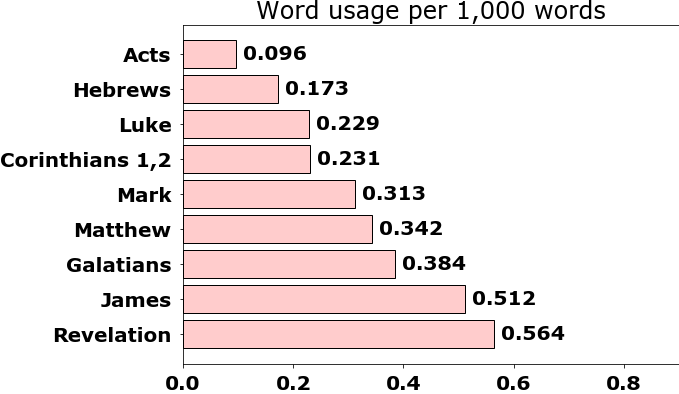
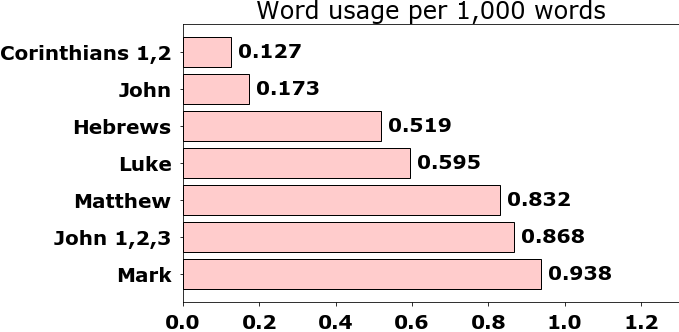
- *G3398 *30 μικρός (mik-ros') : mikroteros mik-rot'-er-os apparently a primary word; small (in size, quantity, number or (figuratively) dignity):--least, less, little, small.
μικρων *7 of 30
Matthew 10:42 And whosoever shall give to drink unto one of these little ones a cup of cold ...
Matthew 18:6 ... shall offend one of these little ones which believe in ...
Matthew 18:10 ... not one of these little ones; for I say ...
Matthew 18:14 ... that one of these little ones should perish.
Mark 9:42 ... shall offend one of these little ones that believe in me, ...
Luke 17:2 ... he should offend one of these little ones.
Revelation 19:18 ... and bond, both small and great.
38. Words
Jesus does not use the same word for
"children". Might the nuance of the meanings be different?
In the
plural,
"sons" can refer to a
mixed group including "
daughters".
"τᾰ̀ παιδῐ́ᾰ" ≈ "the children" (neuter plural).
"ἡ παιδῐᾱ́" ≈ "childish play, fun, sport, game" (feminine singular).
"αἱ παιδῐαί" ≈ "childish play, fun, sport, game" (feminine plural).
"μικρῶν" ≈ "(of) little, trivial, short, young", source of English "micro".
παιδιά
39. Verily I say to you: connect the dots
Matthew 25:12 But he answered and said, Verily I say unto you, I know you not. [kjv]
ο δε αποκριθεις ειπεν αμην λεγω υμιν ουκ οιδα υμας [gnt]
Jesus uses the phrase
"verily" or
"amen",
"(I) say" "(to) you" (plural)
25 times and (singular)
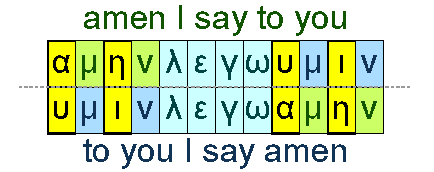
2 times in Matthew. Since Matthew is writing down what Jesus says, the exact placement of this phrase appears to be important.
The "amen" in the Greek was changed, when spoken by Jesus at the beginning of a phrase, sometime in the Middle Ages, to "verily". The Latin Vulgate uses the "amen" instead of the Latin "verily".
The phrase itself is a symmetrical play on words with the "amen" similar to the "(to) you".
This model appears to fit when the
"(to) you" is
singular and
not plural.
40. Verily I say unto you: connect the dots
Some (theologians, commentators, pastors, etc.) say that the phrase is used to introduce an important concept. Is what Jesus says ever
unimportant?
Instead, the phrase appears to be used to connect the previous thought (excluding scripture quotation) with the next thought as similar in some way.
In some cases, the two thoughts are stated in a
top-down backward-chaining manner so that it helps to consider the second thought before the first thought.
Student:
Are we doing anything important today in class?
41. Matthew 18:2-3 Verily I say unto you
Matthew 18:2 And Jesus called a little child unto him, and set him in the midst of them, [kjv]
και προσκαλεσαμενος ο ιησους παιδιον εστησεν αυτο εν μεσω αυτων [gnt]
18:3 And said, Verily I say unto you, Except ye be converted, and become as little children, ye shall not enter into the kingdom of heaven. [kjv]
και ειπεν αμην λεγω υμιν εαν μη στραφητε και γενησθε ως τα παιδια ου μη εισελθητε εις την βασιλειαν των ουρανων [gnt]
Matthew 18:2 ...παιδιον ... (a child, singular, the one in the middle)
Matthew 18:3: ... as τα παιδια ... (the children, plural)
Matthew 18:4: ... το παιδον τουτο ... (this child, singular, the one in the middle)
The
one as
a child is in the
middle. Who are
the children? Jesus tends to so the "
verily I say unto you" (in this case plural) to tell the reader to
connect the
previous and
following thoughts. Where exactly are the previous thoughts? How about at the end of the previous chapter where Jesus makes an "
as" comparison.
42. Matthew 18:1-3 A child and the children
Matthew 18:1 At the same time came the disciples unto Jesus, saying, Who is the greatest in the kingdom of heaven? [kjv]
εν εκεινη τη ωρα προσηλθον οι μαθηται τω ιησου λεγοντες τις αρα μειζων εστιν εν τη βασιλεια των ουρανων [gnt]
18:2 And Jesus called a little child unto him, and set him in the midst of them, [kjv]
18:3 And said, Verily I say unto you, Except ye be converted, and become as little children, ye shall not enter into the kingdom of heaven. [kjv]
Verse one says "
at the same hour/time". To compare what Jesus will now say with what happened before one must go back to the end of the temple tax verses and the end of the previous chapter.
How does one relate being
"turned around" as
"the children" (
plural) relate to the
one "child" in the
"middle" (
singular)? Might the
"child" in the
"middle" a distractor that applies to other verses and
not verse 3.
43. Matthew 17:26 Children
Matthew 17:26 Peter saith unto him, Of strangers. Jesus saith unto him, Then are the children free. [kjv]
λεγει αυτω ο πετρος ειποντος δε απο των αλλοτριων εφη αυτω ο ιησους αραγε ελευθεροι εισιν οι υιοι [gnt]
Might the
"the sons" (as a mixed group,
"children") in Matthew 17:26 be related to
"the children" in Matthew 18:3?
An "entrapment" is mentioned. Does it relate to a "millstone"?
Find a fish in the sea. Find a sheep having gone down from the mountain.
44. Bigger picture
Here is one way to look at the temple tax verses in Matthew 17:24-27.
The religious establishment grabs Peter by the throat (entrapment), so to speak, and says - will (you and) Jesus pay? How is this different from the unforgiving servant demanding that the fellow servant pay (one hundred, all together, through a lamb/bird) - if he owes?
Instead of thinking yes-yes no-no, Peter answers for Jesus. Is it a sin to speak for Jesus without consulting him? How does Jesus handle this sin?
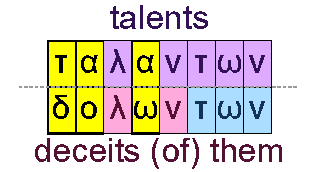
Jesus interacts with Peter, reasoning with him, and gains his brother. That is, the children (they) are free (from the tax). How is this different from the persons with five and two talents gaining but five and two talents (respectively)? Who has found whom?
Can Peter be compared to a sheep that (is led) astray through some (millstone) entrapment. Jesus (takes the initiative and) finds him and reasons with him. Is Jesus as the shepherd rejoicing to have found Peter (the lost sheep)? Is Peter (the lost sheep) rejoicing to have found Jesus (the shepherd) who has explained the way back?
Nevertheless, to avoid entrapping the religious establishment (who think that they are great), Jesus finds a way to way to pay (avoiding conflict) that shows the true motives of the religious establishment.
45. Matthew 5:41 Paraphrase
Matthew 5:41 And whosoever shall compel thee to go a mile, go with him twain. [kjv]
και οστις σε αγγαρευσει μιλιον εν υπαγε μετ αυτου δυο [gnt]
5:41 Paraphrase:
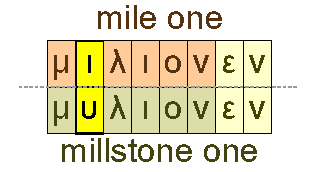
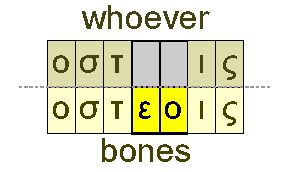
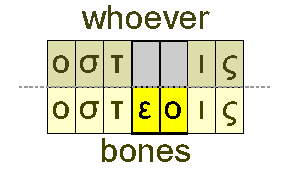
Whosoever [enemy, hostile, bones] you compels (to be a messenger) (with it( message)) mile one [indistinct (message), millstone] go away with it (message) two [of God].
|
Greek: ... μελαιναν (dark, dim, indistinct)
Greek: ... μιλιον εν (mile one)
Greek: ... μυλιον εν (millstone one)
|
The "message" appears to be the
"Holy Spirit" which in these verses is only
indirectly referenced using pronouns.
|
Example: Paul was compelled as a messenger of the religious institution to go one mile (with an indistinct message). Instead, he changed course (turned the jaw bone or cheek) and went two miles (and more) with a message of God. [military common sense]
46. Matthew 5:39 Turning the other cheek
Matthew 5:39 But I say unto you, That ye resist not evil: but whosoever shall smite thee on thy right cheek, turn to him the other also. [kjv]
εγω δε λεγω υμιν μη αντιστηναι τω πονηρω αλλ οστις σε ραπισει επι ραπιζει εις την δεξιαν σου σιαγονα σου στρεψον αυτω και την αλλην [gnt]
Should one not "resist" "the evil"? Should one let "the evil" have it's way?
Who is meant by "whosoever"?
The Greek translated as "on" is that of "into".
What does it mean to "smite"? It (s) might be something else.
The Greek for "cheek" is that of a "jaw bone".
Why the "right" "cheek" and not the "left" "cheek"?
The Greek translated as "him" (person) can be "it" (that which you are doing).
What is the "other" "it" to which one is to "turn"?
47. Big picture
How is the message Peter is compelled to go with mile one (millstone one) comparable to the millstone deception/entrapment (in a few verses) and the ten thousand (millstone) talents (deceptions/enticements) later in the next chapter?
Notice how Peter, through Jesus, has turned around how he would otherwise think about being great or thinking about being great in both reality and how to handle that reality. Might one say that
"the children" have
"turned around"?
As
"little children", do we need to
"turn around" about both being great and thinking about being great (or who is great)? Is this just an abstract idea or is there a concrete physical manifestation of
"turning around"?
48. Matthew 18:3-4 As an analogy
Matthew 18:3 And said, Verily I say unto you, Except ye be converted, and become as little children, ye shall not enter into the kingdom of heaven. [kjv]
και ειπεν αμην λεγω υμιν εαν μη στραφητε και γενησθε ως τα παιδια ου μη εισελθητε εις την βασιλειαν των ουρανων [gnt]
18:4 Whosoever therefore shall humble himself as this little child, the same is greatest in the kingdom of heaven. [kjv]
οστις ουν ταπεινωση ταπεινωσει εαυτον ως το παιδιον τουτο ουτος εστιν ο μειζων εν τη βασιλεια των ουρανων [gnt]
The ancient Greek word
"ως" ≈ "as". This indicates that this is a
comparison or
analogy and
not an actual reality. [
as a dove/pigeon,
as a drop of blood,
as a house built on sand, etc.]
49. Matthew 18:2-4 Believers as children
Matthew 18:2 And Jesus called a little child unto him, and set him in the midst of them, [kjv]
και προσκαλεσαμενος ο ιησους παιδιον εστησεν αυτο εν μεσω αυτων [gnt]
18:3 And said, Verily I say unto you, Except ye be converted, and become as little children, ye shall not enter into the kingdom of heaven. [kjv]
και ειπεν αμην λεγω υμιν εαν μη στραφητε και γενησθε ως τα παιδια ου μη εισελθητε εις την βασιλειαν των ουρανων [gnt]
18:4 Whosoever therefore shall humble himself as this little child, the same is greatest in the kingdom of heaven. [kjv]
οστις ουν ταπεινωση ταπεινωσει εαυτον ως το παιδιον τουτο ουτος εστιν ο μειζων εν τη βασιλεια των ουρανων [gnt]
"παῖς" ≈ "child, servant" is one who is to learn from and follow the example of a parent (or teacher or master).
"παιδίον" ≈ "child" of any age up to about 12 (due to the diminutive suffix).
Jesus, Paul, etc., use the word for a
"child" to refer to
believers (of all ages). Such
believers are often known as
"sheep".
50. Matthew 18:2-3 Stand and be turned
Matthew 18:2 And Jesus called a little child unto him, and set him in the midst of them, [kjv]
και προσκαλεσαμενος ο ιησους παιδιον εστησεν αυτο εν μεσω αυτων [gnt]
18:3 And said, Verily I say unto you, Except ye be converted, and become as little children, ye shall not enter into the kingdom of heaven. [kjv]
και ειπεν αμην λεγω υμιν εαν μη στραφητε και γενησθε ως τα παιδια ου μη εισελθητε εις την βασιλειαν των ουρανων [gnt]
The Greek for
"set" is that of
"stand". Here, Jesus acts and Matthew writes that the
"child" is
"stood" in the
"midst" or
"middle"
The Greek for
"converted" is that of
"turned around". That is, from verse one, from concerned about being the
"greatest" to concerned about what Jesus wants them to do.
51. Matthew 18:2-3
Matthew 18:2 And Jesus called a little child unto him, and set him in the midst of them, [kjv]
και προσκαλεσαμενος ο ιησους παιδιον εστησεν αυτο εν μεσω αυτων [gnt]
18:3 And said, Verily I say unto you, Except ye be converted, and become as little children, ye shall not enter into the kingdom of heaven. [kjv]
και ειπεν αμην λεγω υμιν εαν μη στραφητε και γενησθε ως τα παιδια ου μη εισελθητε εις την βασιλειαν των ουρανων [gnt]
Both the words for
"stand" "
against" "
evil" and to
"turn" the other (
cheek) are used in Matthew 5:39. Might these verses be related in a deeper sense?
☐
"turn" from
wanting to be the
"greatest" or even
thinking about who is the
"greatest".
☐
"turn" from doing what the
"birds" want you to do so you can be called
"great" but is intended to make the
"birds" look
"great".
52. Strongs - turned
*G4762 *22 στρέφω (stref'-o) : strengthened from the base of G5157; to twist, i.e. turn quite around or reverse (literally or figuratively):--convert, turn (again, back again, self, self about).
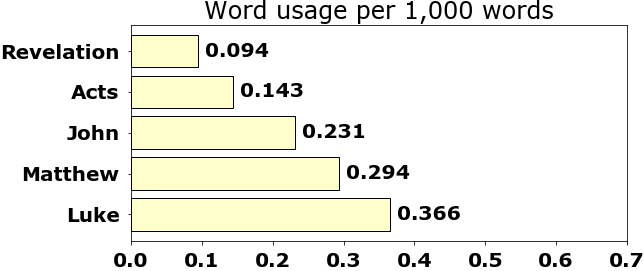 |
Words: εστραφη εστραφησαν εστρεψεν=2 στραφεις=11 στραφεισα στραφεντες στραφητε=1 στραφωσιν στρεφειν στρεφομεθα στρεψον=1
|
The ancient Greek word
"στρέφω" ≈ "turn, direct, twist" and is related to the English word
"strap" as "
fasten". The
modern Greek word
"στρέφω" (STREH-fo) ≈ "turn, direct".
The English word
"strep" is a short form of
"streptococcus", coined in 1877 by Viennese surgeon Albert Billroth (1829-1894) from two
ancient Greek words.
"στρεπτός" ≈ "twisted, pliant".
"κόκκος" ≈ "grain, seed" as in the mustard "seed" and color "red".
53. Usage - turned
- *G4762 *22 στρέφω (stref'-o) : strengthened from the base of G5157; to twist, i.e. turn quite around or reverse (literally or figuratively):--convert, turn (again, back again, self, self about).
- στρεψον *1 of 22
- Matthew 5:39 ... thy right cheek, turn to him the other also.
- στραφητε *1 of 22
- Matthew 18:3 ... I say unto you, Except ye be converted, and become as ...
The
turning words used by Jesus in Matthew 5:39 to
"turn" the other (
cheek) and by Jesus in Matthew 18:3 to be
"converted" are the same base word and each is used only
one time in the
GNT (Greek New Testament).
Might these verses be related in a deeper sense? If you keep going in the same direction you have
not "turned".
54. Matthew 7:16 Great grapes
55. Matthew 18:3 Great grapes
Matthew 18:3 And said, Verily I say unto you, Except ye be converted, and become as little children, ye shall not enter into the kingdom of heaven. [kjv]
και ειπεν αμην λεγω υμιν εαν μη στραφητε και γενησθε ως τα παιδια ου μη εισελθητε εις την βασιλειαν των ουρανων [gnt]
The
ancient Greek word
"στραφῆτε" ≈ "turn around" has the
onomatopoeic sense of a bird call.
The
ancient Greek word
"στᾰφῠλή" ≈ "grape" and
"σταφυλᾱ́ς" ≈ "bunch of grapes" (accusative plural).
It appears one needs to
"turn" to being a
"grape" and not a "
thorn". What a
"grape" idea! The "
sheep" must have had a "
herd" by the
"grapevine".
[turn vs. repent as think after]
56. Matthew 5:39 Turning
Matthew 5:39 But I say unto you, That ye resist not evil: but whosoever shall smite thee on thy right cheek, turn to him the other also. [kjv]
εγω δε λεγω υμιν μη αντιστηναι τω πονηρω αλλ οστις σε ραπισει επι ραπιζει εις την δεξιαν σου σιαγονα σου στρεψον αυτω και την αλλην [gnt]
The ancient Greek word
"στρέφω" ≈ "turn, direct, twist" and is related to the English word
"strap" as "
fasten". The modern Greek word
"στρέφω" (STREH-fo) ≈ "turn, direct".
The Greek word translated as
"smite" can be a play on words with the Latin word for
"rapid". Jesus some Latin words and Latin play on words in this short verse sequence. False leaders as "
birds" who use "
deception" will want you to be in a
"hurry" as an "
urgent priority" so that you will not think too much about what you are actually doing.
In
"turning" the
"cheek" one is acting "
passively". In Greek, the word for "
passive" is often translated as "
suffering".
57. Matthew 5:39 The evil eye
Matthew 5:39 But I say unto you, That ye resist not evil: but whosoever shall smite thee on thy right cheek, turn to him the other also. [kjv]
εγω δε λεγω υμιν μη αντιστηναι τω πονηρω αλλ οστις σε ραπισει επι ραπιζει εις την δεξιαν σου σιαγονα σου στρεψον αυτω και την αλλην [gnt]
The Greek for
"evil" is in the
dative case so it is
"the evil" or
"(with respect to) the evil" and
not just
"evil" in general.
Note that
not "standing against" "evil" does not mean that one is "
supporting" or "
advocating"
"evil". One is just a bystander, neither condoning nor supporting nor participating in
"evil".
Discuss: Should one actively "
go to war" or "
crusade" against what is considered an
"evil"? Once the double meanings, play on words, and code word meanings in this verse are used, this question should be more clear.
58. Matthew 18:3 Come into being
Matthew 18:3 And said, Verily I say unto you, Except ye be converted, and become as little children, ye shall not enter into the kingdom of heaven. [kjv]
και ειπεν αμην λεγω υμιν εαν μη στραφητε και γενησθε ως τα παιδια ου μη εισελθητε εις την βασιλειαν των ουρανων [gnt]
The Greek for
"become" is that of
"come into being" using the same word that in John 3 was taken as
"born again".
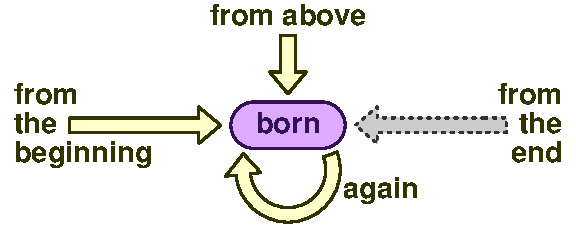
The ancient Greek word
"γίγνομαι" ≈ "come into being" and is the source of the English word
"genesis". The context may indicate being born, being produced, taking place, etc.
This important word will appear two more times in this discourse and be translated in the
KJV (King James Version) as
"become",
"have" and
"shall be done". This obscures the meaning of what Jesus is saying.
59. Matthew 18:2-3 Children
Matthew 18:2 And Jesus called a little child unto him, and set him in the midst of them, [kjv]
και προσκαλεσαμενος ο ιησους παιδιον εστησεν αυτο εν μεσω αυτων [gnt]
18:3 And said, Verily I say unto you, Except ye be converted, and become as little children, ye shall not enter into the kingdom of heaven. [kjv]
και ειπεν αμην λεγω υμιν εαν μη στραφητε και γενησθε ως τα παιδια ου μη εισελθητε εις την βασιλειαν των ουρανων [gnt]
The "little child" is an "as" analogy and refers to "believers" of any age.
The "set" is that of "stand" as in not "standing" for or "in place of" "evil" or "oppression".
The "converted" is that of "turned around" (from being "great").
The "become" is that of "coming into being" as in being "born" "again".
The "child" is in the "middle" of both "good" and "evil" or "oppressive" entities.
60. Matthew 18:3 Children
Matthew 18:3 And said, Verily I say unto you, Except ye be converted, and become as little children, ye shall not enter into the kingdom of heaven. [kjv]
και ειπεν αμην λεγω υμιν εαν μη στραφητε και γενησθε ως τα παιδια ου μη εισελθητε εις την βασιλειαν των ουρανων [gnt]
Matthew 17:26 "the children" (plural ) as "the sons".
Matthew 18:3 "the child" (singular) in the "middle" (no information about turning direction).
Matthew 18:4 "the children" (plural).
Might
"the children" in Matthew 18:4 be related to
"the sons" in Matthew 17:26? Did Jesus show Peter how to
"turn" from being
"great" or wanting to be
"great" by just paying the "
temple tax"?
Might they have
"changed direction" from the desire to become the
"greatest" or even know who is the
"greatest"? Might this desire be part of their "
essential attributes" (rich young man in Matthew 19) as in "
everything they have" (unforgiving servant at the end of Matthew 18)?
61. Matthew 18:4 Humbled at the same level
Matthew 18:4 Whosoever therefore shall humble himself as this little child, the same is greatest in the kingdom of heaven. [kjv]
οστις ουν ταπεινωση ταπεινωσει εαυτον ως το παιδιον τουτο ουτος εστιν ο μειζων εν τη βασιλεια των ουρανων [gnt]
The
ancient Greek word
"ταπεινός" ≈ "low-lying, humbled, downcast". The
KJV often translates the Greek word for
"humbled" as
"abased".
How might this
child have been
"humbled"? Does one need to eat
"umble", later
"humble", pie?
Humility is not thinking less of yourself, but thinking of yourself less. C.S. Lewis.
The
"whoever" indicates that one might want to look for another related meaning in play on words. [Paul and Philippians]
62. Matthew 18:4 Humbled at the same level
Matthew 18:4 Whosoever therefore shall humble himself as this little child, the same is greatest in the kingdom of heaven. [kjv]
οστις ουν ταπεινωση ταπεινωσει εαυτον ως το παιδιον τουτο ουτος εστιν ο μειζων εν τη βασιλεια των ουρανων [gnt]
Who is "greatest"?
Who is "least"?
|
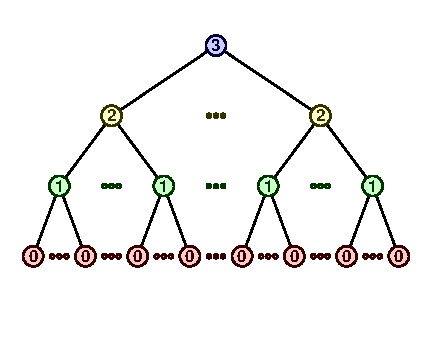
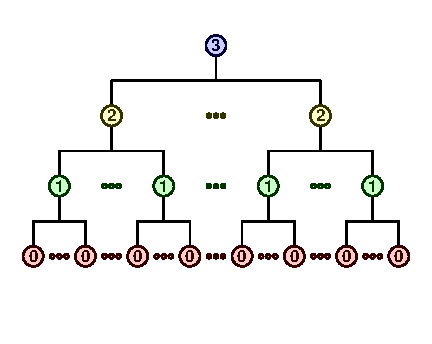
With Jesus as the "head" , every "hair" or "believer" is both "greatest" and "least".
|
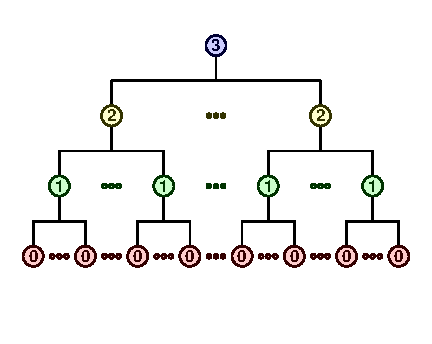 |
Jesus has a flat organizational chart.
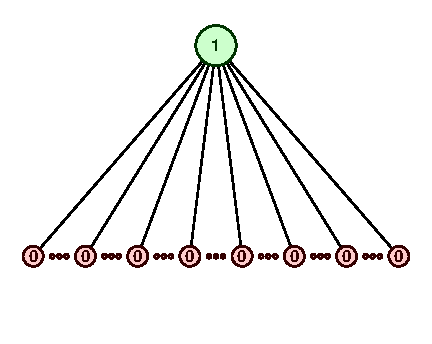
[No child left behind. No child gets ahead.]
[The least of these]
|
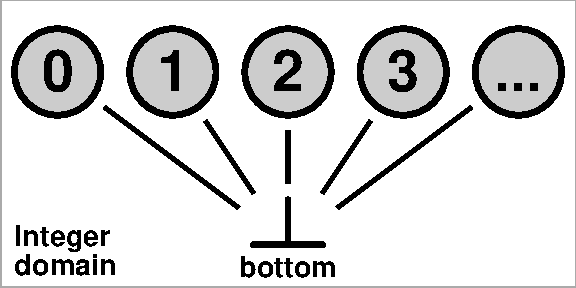 |
This is similar to the semantic domain of integers in programming language theory. Top was not needed for the theory to work.
|
63. Matthew 18:4 Play on words
Matthew 18:4 Whosoever therefore shall humble himself as this little child, the same is greatest in the kingdom of heaven. [kjv]
οστις ουν ταπεινωση ταπεινωσει εαυτον ως το παιδιον τουτο ουτος εστιν ο μειζων εν τη βασιλεια των ουρανων [gnt]
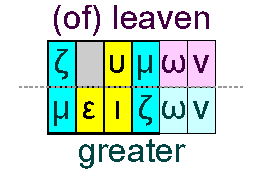
Greek: ... humble oneself ... is the greatest in ...
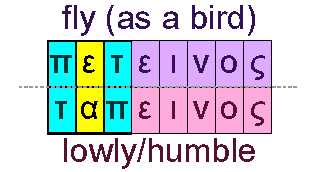
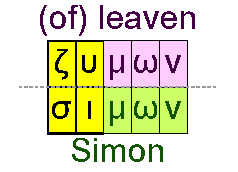
Play: ... fly (as a bird) oneself ... is the leaven (false doctrine, "Simon") in ...
Would the "
church" represented as
"Simon" "
Peter", ever have anything to do with
"leaven" or trying to
"fly as a bird"? How about
Cardinals? Are they ever
unhinged?
"μείζων" ≈ "greater, larger" in a comparative sense.
"ζῡμῶν" ≈ "leaven" (genitive plural) from "ζύμη" ≈ "yeast, dough".
"σιμων" ≈ "Simon" as in Simon Peter (rock of the church).
64. Matthew 18:5 On the name of mine
Matthew 18:5 And whoso shall receive one such little child in my name receiveth me. [kjv]
και ος εαν δεξηται παιδιον τοιουτον εν παιδιον τοιουτο επι τω ονοματι μου εμε δεχεται [gnt]
The
ancient Greek word
"ἐπί" ≈ "on, upon" as in the prefix of the English word
"epicenter" which is, literally, "
on the center". The
KJV translates as
"in" my "name" the Greek that it
"on" the "name" of
mine. The
"on", as a contrast, will become important in a few verses where
"on" will be translated as
"into".
The
ancient Greek word
"ὄνομα" ≈ "name, noun" is related to Latin
"nomen" ≈ "name, noun" (semantic loan from Greek) and English
"name". One must distinguish
"names" which are abstract letters combined to make a word and the "
meaning" to which the word or
"name" is attached. The "
meaning" depends on context.
65. Matthew 18:5 If received or accepted
Matthew 18:5 And whoso shall receive one such little child in my name receiveth me. [kjv]
και ος εαν δεξηται παιδιον τοιουτον εν παιδιον τοιουτο επι τω ονοματι μου εμε δεχεται [gnt]
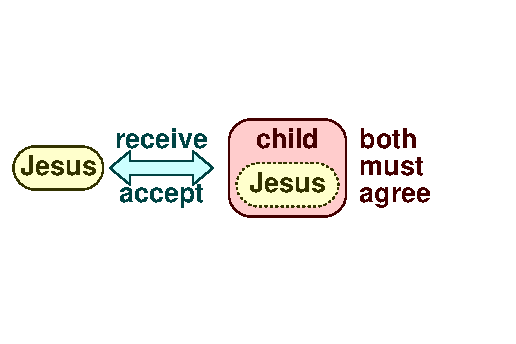
The ancient Greek word
"δέχομαι" ≈ "receive, accept, take, believe". The use of
"receive" or
"accept" word twice ensures that this is a
commutative relationship in that it goes
both ways and sets up an
equality of sorts. This becomes important at the end of the discourse.
Paraphrase:
And if someone receives/accepts one little child such as this on the name of mine receives/accepts me.
Does this mean that one only has to
"accept" a
"child" that has
"accepted" Jesus to have
"accepted" Jesus? Does this make sense? Would false leaders or false teachers
"accept" a
"child" in order to use them for their own purposes?
Most translations
omit the ancient Greek word
"ἐάν" ≈ "if, when". This is a
conditional that creates a
dependency. Who is the
"one" "little child"? Might they give
bad gifts to their
children?
Who is the
"one" "little child"? Reflexive or self-referential relationships are important both in computer science and in some things said by Jesus. Think of the "
one cookie rule".
66. Matthew 18:5 Accept goes both ways
Matthew 18:5 And whoso shall receive one such little child in my name receiveth me. [kjv]
και ος εαν δεξηται παιδιον τοιουτον εν παιδιον τοιουτο επι τω ονοματι μου εμε δεχεται [gnt]
This
"little child" could be anyone. The most important
"little child" is
you (one cookie rule).
You are that
"one" "little child"! What happens if
you as that
"one" "little child" do not
"receive" or
"accept" "on" the "
name" of Jesus? Including the
"if" in the translation makes this correspondence more clear.
Paraphrase:
And if you receive/accept, as a little child, on the name of me (Jesus), you receive/accept me (Jesus).
The
"accept" or
"receive" is used
twice in a
commutative or
both ways relationship. That is,
both of the
two, Jesus and
you, must "
agree" for the relationship to be valid. Otherwise, it will
not be completed or done. The two are "
glued" together.
This
commutative and
reflexive connection with
you becomes important in understanding an otherwise enigmatic verse at the end of the discourse. Such a relationship does
not mean that the usual interpretation is invalid.
67. Usage - receive
*G1209 *56 δέχομαι (dekh'-om-ahee) : middle voice of a primary verb; to receive (in various applications, literally or figuratively):--accept, receive, take. Compare G2983.
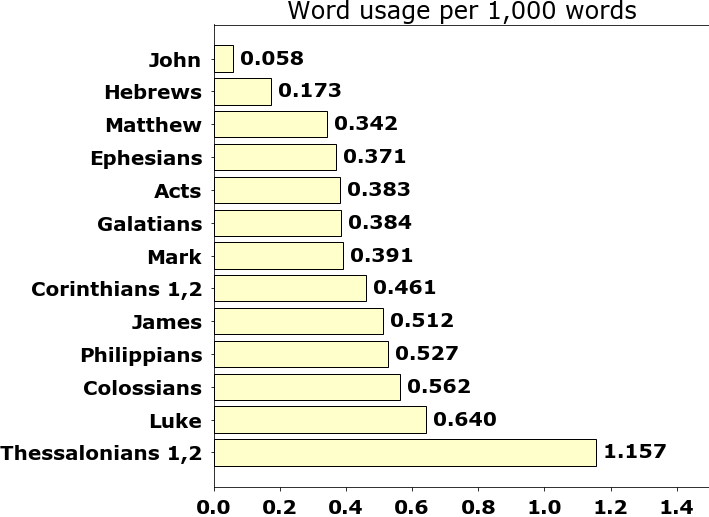 |
Words: δεδεκται δεξαι=3 δεξαμενη δεξαμενοι δεξαμενος=3 δεξασθαι=3 δεξασθε=4 δεξηται=8 δεξωνται=2 δεχεται=8 δεχηται δεχομενος=4 δεχονται δεχωνται=3 εδεξαμεθα εδεξαντο=5 εδεξασθε=4 εδεξατο=3
|
The ancient Greek word
"δέχομαι" ≈ "receive, accept, take, believe".
68. Matthew 18:6-9
Matthew 18:6 But whoso shall offend one of these little ones which believe in me, it were better for him that a millstone were hanged about his neck, and that he were drowned in the depth of the sea. [kjv]
18:7 Woe unto the world because of offences! for it must needs be that offences come; but woe to that man by whom the offence cometh! [kjv]
18:8 Wherefore if thy hand or thy foot offend thee, cut them off, and cast them from thee: it is better for thee to enter into life halt or maimed, rather than having two hands or two feet to be cast into everlasting fire. [kjv]
18:9 And if thine eye offend thee, pluck it out, and cast it from thee: it is better for thee to enter into life with one eye, rather than having two eyes to be cast into hell fire. [kjv]
Jesus now changes Greek words from "
children" to "
little ones". Why might that be?
69. Thank you
70. End of page