Send
Close Add comments:
(status displays here)
Got it! This site "www.creationpie.org" uses cookies. You consent to this by clicking on "Got it!" or by continuing to use this website. Note: This appears on each machine/browser from which this site is accessed.
About Creation PIE
1. About Creation PIE
This content is being developed.
2. Benham disk and Fechner colors
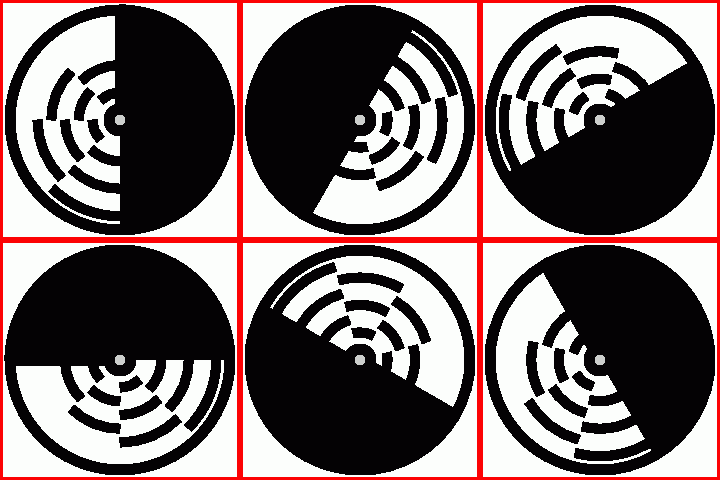
A
Benham disk, when spun fast enough, produces
Fechner colors. The eye sees these dark shades of red (or brown), a shade of green and dark blue rather than black and white.
How might we "
fact check" the
colors we see for "
misinformation"?
3. About Creation PIE
What is "
Creation PIE" about and why might you want to know? How many times have you ever heard "
The Bible is the truth"? What does that mean? What does it mean for something to be "
true"?
That is part of what "
Creation PIE" is all about. The "
creation" part is about how the reality of the universe and how it came into existence. The
PIE (Proto Indo-European) part has a number of complementary parts.
Languages
There are more connections, such as science, statistics, etc., but those do not fit as nicely into the
PIE acronym.
4. Creation Pie logo
Here is a version of the Creation Pie logo from February 21, 2009. Parts of the logo include the following.
Exponential constant e.
Mathematical constant π.
Benham disk
Fechner colors (dark blue, shade of green, brown)
When the disk is not moving, one sees black and white. When the disk is spinning, one sees Fechner colors. I see dark blue, a shade of green and brown. Do those colors actually exist? Are they only in the mind?
How do you know that what you see is actually
true? What does it mean to be
true?
5. PIE: The mathematical and logical connection
The mathematical and logical part is where "
PIE" consists of, first, "
Pi", the Greek letter «
π» as a mathematical transcendental constant that is the circumference of a mathematical circle divided by the diameter of that circle, and the mathematical transcendental constant "
e" as the natural exponential function that plays an important part on the analysis of geometric sequences of growth.
The mathematical connection is, in part, a view of man's effort to understand and reason with logically the reality of the world as it appears to exist.
6. Equations
That is, if the
radius is
r then the
circumference c is as follows.

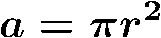
The
area a of a
circle with radius
r is as follows.
The
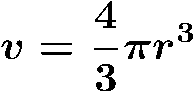
volume v of a
sphere with radius
r is as follows.
[Aristotle, Paul]
7. Exponential constant
The letter "
e" in "
Pie" is associated with the transcendental number
e defined as the natural exponential function whose first derivative (slope) is itself, as expressed in the following equation.
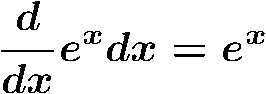
The exponential constant
e plays an important role in geometric sequences of growth (positive or negative).
The mathematical connection is, in part, a view of man's effort to understand and reason with logically the reality of the world as it appears to exist.
8. Page count over time
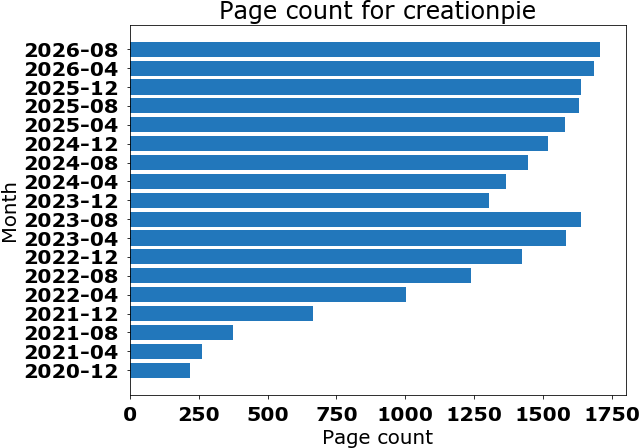
Here is a horizontal bar graph of the page count over time.
In mid 2023 I developed a way to include blocks of content in other content without replicating files and pages. This allowed me to reduce the page count by about 400 pages. Since then, the content has been gradually increasing. I continue to combine content (and reduce pages) when it makes sense to do so.
9. Custom image count over time
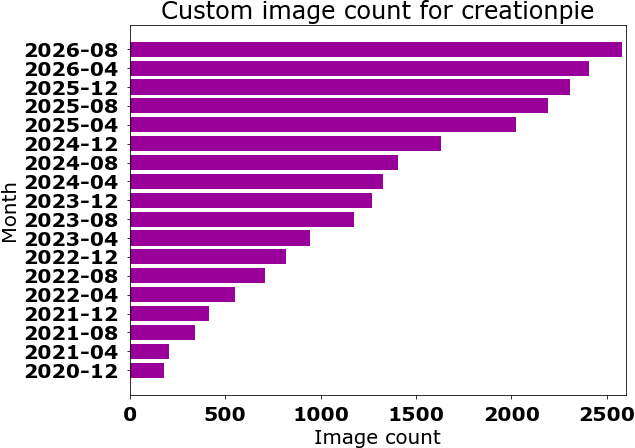
Here is a horizontal bar graph of (some of) the custom-programmed image count over time. Only those used are counted. Most are created using PostScript. Some (with similar patterns) are created using Python that is integrated into the formatting system.
10. PIE: Computation, information and evaluation connection
The ideas of computation (computer science in theory), information (data and information science), and evaluation (technology, computer science in practice) are important in establishing connections to reality that transcend time and space.
The definition of science has changed over time (which is interesting in and of itself). Despite what one may hear from time to time, science cannot prove the Bible true, and science cannot prove the Bible false.
Science is concerned with the reality of time and space as we experience it. The Bible makes claims that go outside of time and space as we know it. Thus it is not at all clear how one would verify a truth that transcends time and space.
The concept of information goes outside of science. It is here that we can hope to find some way to verify the truth of the Bible.
In reasoning about the truth of the Bible, it becomes important to use modern techniques of information and computer (computation) science. The same techniques that can be used to verify truth in the information age (e.g., in the fields of security, program correctness, etc.), can be used to verify the truth of the Bible as a message from a creator outside of space and time.
Why would we want to use such modern methods? Have these techniques been used in the past? Well yes, but only a few individuals have in times past used such techniques. However, those individuals include Isaiah, Jeremiah, Jesus, John, Peter, and Paul, and some others.
So the third connection of "
PIE" is somewhat contrived to fit the letters, but is the following.
The "P" is for procedures or algorithms - ways to deal with information.
The "I" is for information or data.
The "E" is for evaluation of the information/data by procedures/algorithms.
11. Professional research: formatting systems
Part of my professional research, related to my PhD (computer science) in applied programming language theory (lazy functional systems) involves sophisticated text formatting systems (i.e,, string rewriting systems with lazy evaluation principles). In simple terms, this involves programs that write programs that write programs, etc., using a hierarchy of abstractions.
So, for example, the same source files, images, audio, etc., are used to generate Word documents, PowerPoint presentations, web pages, handouts, questions for exam generation and grading, etc. In doing this type of applied research, it is hard to get good test data to work on since the test data would be content that needs formatted at many levels of target generation.
Whenever teaching, I could use student notes for class for creating such content. Recently, I have been using a number of my web domains and web sites to both develop interesting (to me) content that I can also use to refine ideas for sophisticated text formatting.
So when I find that some page, slide, document, etc., does not look quite right, it is usually the same issue in many places. When I discover and adjust that part, then everything gets adjusted. Part of the system not only allows me to format one document, presentation, page, etc., but to automatically update all needed parts of the system, including update to any web sites.
12. Bible versions
On this site, some Bibles verses used include the following versions. Note that the letter abbreviation in brackets is the internal verse version key that may appear in some verse references.
[b] The King James Bible is from 1769.
[ty] The William Tyndale Bible is from 1525/1530.
[wy] The John Wycliffe Bible is from 1395.
[ge] The German Darby Bible is from 1905, the "Darby Unrevidierte Elberfelder".
[lu] The German Martin Luther Bible is from 1545, the "Unrevidierte Luther Ersetzung".
[dr] The DR (Douay-Rheims) Bible is a direct translation of the Latin Vulgate, which can make the Latin easier to follow.
[v] The Latin Vulgate is a translation by Jerome.
[x] The Greek New Testament manuscripts include the TR (Textus Receptus) and WH (Westcott Horte) as part of the GNT (Greek New Testament).
[x] The Greek Old Testament manuscripts include the LXX (Septuagint).
[bs3] The Brenton Septuagint English translation.
The Greek Bible [x] includes the
LXX and the
GNT with markings for differences between
TR and
WH. Note also that some Greek (and other) texts from Crosswire.org do not include accents. Note also that the original manuscripts also did not include accents.
13. Disclaimers
This site and the content presented is intended to make you think about logically promoting and defending Bible truth using concepts of information, computation, languages, history, science and the Bible. Not every one will agree on what is presented. There may be parts that could be presented in a different manner. If you disagree, then hopefully what is presented will have made you think about why you believe what you believe.
14. End of page