Send
Close Add comments:
(status displays here)
Got it! This site "www.creationpie.org" uses cookies. You consent to this by clicking on "Got it!" or by continuing to use this website. Note: This appears on each machine/browser from which this site is accessed.
Matthew 18:21-22 The forgiving tymes they are a changin
1. Matthew 18:21-22 The forgiving tymes they are a changin
2. Stupid questions
Have you ever heard a teacher say "
there are no stupid questions"? Are there "
stupid people who ask questions"?
Example: Dorothy to the Scarecrow in the Wizard of Oz:
What would you do with a brain if you had one?
In academia, a "
stupid question" can be defined as a question asked by a student for which the answer has already been given or a question that does not relate to the current discussion, or
both!
Two things are infinite: the universe and human stupidity; and I'm not sure about the universe. Albert Einstein's (Physicist)
3. Matthew 18:15 Question by Peter
Matthew 18:15 Moreover if thy brother shall trespass against thee, go and tell him his fault between thee and him alone: if he shall hear thee, thou hast gained thy brother. [kjv]
εαν δε αμαρτηση εις σε ο αδελφος σου υπαγε και ελεγξον αυτον μεταξυ σου και αυτου μονου εαν σου ακουση εκερδησας τον αδελφον σου [gnt]
From what Jesus said in Matthew 6 in the Lord's Prayer as "
debts" and "
trespasses" and in the verses after as "
stupid things", there is no limit placed on the number of times one should "
forgive" or "
let go" in situations much more inclusive than just "
sin" or "
trespass" that are "
against me"!
These verses have to do with church conflict.
4. Matthew 18:21 Question by Peter
Matthew 18:21 Then came Peter to him, and said, Lord, how oft shall my brother sin against me, and I forgive him? till seven times? [kjv]
τοτε προσελθων αυτω ο πετρος ειπεν αυτω κυριε ποσακις αμαρτησει εις εμε ο αδελφος μου και αφησω αυτω εως επτακις [gnt]
The words used by Jesus in verse 15 (third person) and the words used by Peter in verse 21 (first person) are the same except Peter adds
"against me". Both here and in chapter 6 what Jesus says subsumes
"against me". Discuss:
Did Peter ask a "stupid question"? Note that Peter (and others) often ask questions that others would ask.
How many sermons have you heard about how many times one should forgive, or let go, of a sin against oneself?
How many sermons point out that the answer has already been provided in Matthew 6 and/or the question is not relevant to what Jesus had been saying?
Why might that be the case?
5. Matthew 18:21
KJV: Then came Peter to him, and said, Lord, how oft shall my brother sin against me, and I forgive him? till seven times?
Greek: τοτε προσελθων αυτω ο πετρος ειπεν αυτω κυριε ποσακις αμαρτησει εις εμε ο αδελφος μου και αφησω αυτω εως επτακις
Latin: tunc accedens Petrus ad eum dixit Domine quotiens peccabit in me frater meus et dimittam ei usque septies
Wessex: Ða ge-nehlahte petrus to hym & cwaeð. drihten gyf min broðer synegað wið me mot ic hit hym for-gyfan oððet seofe syþan.
Tyndale: Then came Peter to him and sayde: master howe ofte shall I forgeve my brother yf he synne agaynst me seven tymes?
6. Matthew 18:22
KJV: Jesus saith unto him, I say not unto thee, Until seven times: but, Until seventy times seven.
Greek: λεγει αυτω ο ιησους ου λεγω σοι εως επτακις αλλ αλλα εως εβδομηκοντακις επτα
Latin: dicit illi Iesus non dico tibi usque septies sed usque septuagies septies
Wycliffe: Whether til seuen tymes? Jhesus seith to hym, Y seie not to thee, til seuene sithis; but til seuenti sithis seuene sithis.
Tyndale: Iesus sayd vnto him: I saye not vnto the seven tymes: but seventy tymes seven tymes.
7. Matthew 18:1 Greatest
Matthew 18:1 At the same time came the disciples unto Jesus, saying, Who is the greatest in the kingdom of heaven? [kjv]
εν εκεινη τη ωρα προσηλθον οι μαθηται τω ιησου λεγοντες τις αρα μειζων εστιν εν τη βασιλεια των ουρανων [gnt]
|
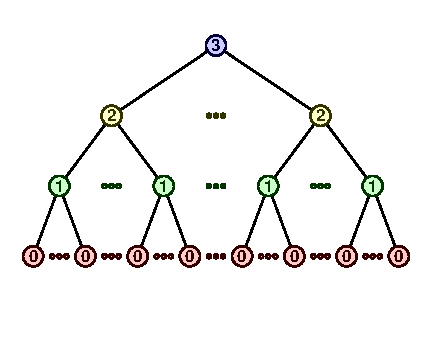
Who is "greatest"?
|
Who is "least"?
|
 |
 |
 |
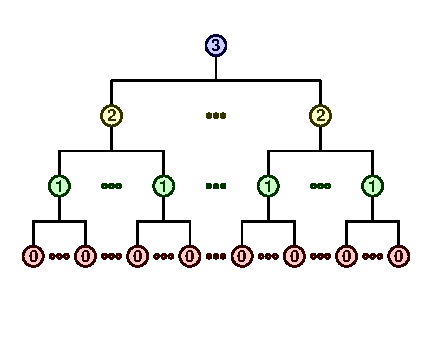 |
Since chapter 17 is concerned with
"greatness" and chapter 18 starts with the question to Jesus of who is
"greatest", the question might have been motivated by chapter 17 and then that idea follows through with everything Jesus says in finishing this discourse in chapter 18.
In modern times, those who think themselves
"great" are sometimes called the "
elite".
8. Matthew 18:21-22 The forgiving tymes they are a changin
Matthew 18:21 Then came Peter to him, and said, Lord, how oft shall my brother sin against me, and I forgive him? till seven times? [kjv]
18:22 Jesus saith unto him, I say not unto thee, Until seven times: but, Until seventy times seven. [kjv]
The title "
The forgiving tymes they are a changin" is inspired by the Bob Dylan lyrics to "
The times they are a changin". The Greek for "
forgive" is that of "
letting go".
Peter does
not use the word "
times" as "
occurrences". It is
inferred and is
not the "
times" operator for multiplication.
18:21: ... seven (occurrences) ...
18:22: ... seventy seven (occurrences) ...
The answer to how many times should one "
forgive" or "
let go" of things done that are not sins and not against us is provided after the Lord's Prayer in Matthew 6. Why did Peter ask this in this context?
9. Matthew 18:21-22 Times
Matthew 18:21 Then came Peter to him, and said, Lord, how oft shall my brother sin against me, and I forgive him? till seven times? [kjv]
τοτε προσελθων αυτω ο πετρος ειπεν αυτω κυριε ποσακις αμαρτησει εις εμε ο αδελφος μου και αφησω αυτω εως επτακις [gnt]
18:22 Jesus saith unto him, I say not unto thee, Until seven times: but, Until seventy times seven. [kjv]
λεγει αυτω ο ιησους ου λεγω σοι εως επτακις αλλ αλλα εως εβδομηκοντακις επτα [gnt]
Peter uses the
ancient Greek word
"ποσάκις" ≈ "how many times, how often" (adverbial). This is not the "
times" operator for multiplication. Each time is one occurrence.
The ancient Greek word
"πόσος" ≈ "how much, how many" and similar concepts and is used to indicate a question.
Jesus provides an answer.
10. Matthew 18:21-22 Times
Matthew 18:21 Then came Peter to him, and said, Lord, how oft shall my brother sin against me, and I forgive him? till seven times? [kjv]
τοτε προσελθων αυτω ο πετρος ειπεν αυτω κυριε ποσακις αμαρτησει εις εμε ο αδελφος μου και αφησω αυτω εως επτακις [gnt]
18:22 Jesus saith unto him, I say not unto thee, Until seven times: but, Until seventy times seven. [kjv]
λεγει αυτω ο ιησους ου λεγω σοι εως επτακις αλλ αλλα εως εβδομηκοντακις επτα [gnt]
Note that there is no Greek word for "
times" as in multiplication or "
and" as in addition. Just the words for
"seventy" and
"seven".
This is then mostly an academic discussion on translation issues since it appears that Jesus is obviously saying one should forgive an unlimited number of times. The pastor kept using the word "
infinite".
What is the difference between an "
unlimited" and an "
infinite" number of times?
11. Unlimited infinity
Matthew 18:22 Jesus saith unto him, I say not unto thee, Until seven times: but, Until seventy times seven. [kjv]
λεγει αυτω ο ιησους ου λεγω σοι εως επτακις αλλ αλλα εως εβδομηκοντακις επτα [gnt]

An unlimited number of times has some basis in reality. The number
2270 is the approximate number of small particles in the known universe. This is not an infinite number, but, for practical purposes, is "
unlimited".
An infinite number of times has the connotation of a mathematical infinity which may or may not have a basis in reality - other than in the mind.
Is an "
all you can eat" buffet infinite? Is it "
unlimited"? A better wording sometimes used is "
all you care to eat".
Some cell phone plans offer "
unlimited" bandwidth, until you read the fine print disclaimers. When you get above a certain threshold, the
bandwidth is throttled so what data transfer becomes slower and slower.
12. Translation issues
13. Sum problems
Matthew 18:22 Jesus saith unto him, I say not unto thee, Until seven times: but, Until seventy times seven. [kjv]
λεγει αυτω ο ιησους ου λεγω σοι εως επτακις αλλ αλλα εως εβδομηκοντακις επτα [gnt]
To
sum it up, many children these days have
sum trouble with
multiplication. There is a
difference of opinion, but
times are tough. And their troubles are
multiplying. Does that
add up? What does the
remainder say about what is
left over?
Enough of play on words, let us look at the verse in more detail. How much difference can there be between a
1 and a
2? That could be a billion dollar question.
14. One or two: billion dollar question
It has actually happened that the difference between
one and
two was a billion dollar question.
After the 9/11 attacks which destroyed the Twin Towers, it became a billion dollar question as to whether it was two separate single attacks or one attack on two targets, etc. The insurance policy covered one billion dollars for each incident. So was it one or two incidents. Lawyers and a court hearing were needed. (It ended up being two separate incidents for one billion dollars each).
15. Genesis 4:24 Fold times
Genesis 4:24 If Cain shall be avenged sevenfold, truly Lamech seventy and sevenfold. [kjv]
… שבעתים … שבעים ושבעה [he]
οτι επτακις εκδεδικηται εκ καιν εκ δε λαμεχ εβδομηκοντακις επτα [lxx]
"ἑπτά" ≈ "seven" - originally starting with an "s" that later dropped off - but stayed in many other PIE (Proto Indo-European) languages.
An interesting verse in Genesis uses the same
"seventy" and
"seven" and was translated the same in the
LXX (Septuagint) and Latin Vulgate as Matthew 18:22.
The exact meaning of the verse is unclear. We are here interested in the numbers.
The
modern Greek word
"επτά" (eh-PTA) ≈ "seven".
16. Genesis 4:24
KJV: If Cain shall be avenged sevenfold, truly Lamech seventy and sevenfold.
Hebrew: כי שבעתים יקם קין ולמך שבעים ושבעה׃
Greek: οτι επτακις εκδεδικηται εκ καιν εκ δε λαμεχ εβδομηκοντακις επτα
Latin: septuplum ultio dabitur de Cain de Lamech vero septuagies septies
Wycliffe: veniaunce schal be youun seuenfold of Cayn, forsothe of Lameth seuentisithis seuensithis.
Tyndale: For Cain shall be avenged sevenfolde: but Lamech seventie tymes sevenfolde.
Luther: Kain soll siebenmal gerochen werden, aber Lamech siebenundsiebenzigmal.
17. Matthew 18:21-22 Middle English
Matthew 18:21 Then came Peter to him, and said, Lord, how oft shall my brother sin against me, and I forgive him? till seven times? [kjv]
τοτε προσελθων αυτω ο πετρος ειπεν αυτω κυριε ποσακις αμαρτησει εις εμε ο αδελφος μου και αφησω αυτω εως επτακις [gnt]
18:22 Jesus saith unto him, I say not unto thee, Until seven times: but, Until seventy times seven. [kjv]
λεγει αυτω ο ιησους ου λεγω σοι εως επτακις αλλ αλλα εως εβδομηκοντακις επτα [gnt]
The Tyndale adds the Middle English word
"tymes" ≈ "times" and the Geneva Bible adds "
times". The other versions use the number
77.
So the same question arises here, is it
70+7=77 or
70*7=490.
Does one increase their "
avenging" by addition or multiplication?
18. Conjecture
A conjecture here is that the English translators used the word "times" as "occurrences" in the first part of the verse, and then, use the "times" as multiplication in the following verse.
Can you think of another possibility?
19. Summary
Is the end of Matthew 18:22
70+7=77 or
70*7=490?
A good translation technique might be to just translate it as "
seventy seven" (in quotes) with a footnote explaining the ambiguity or controversy.
Should you remember and keep count?
Do you want God/Jesus to remember and keep count?
The
hairs (believers) of the
head (Jesus) are all numbered.
20. Matthew 18:21-22 Seventy and seven
Matthew 18:21 Then came Peter to him, and said, Lord, how oft shall my brother sin against me, and I forgive him? till seven times? [kjv]
τοτε προσελθων αυτω ο πετρος ειπεν αυτω κυριε ποσακις αμαρτησει εις εμε ο αδελφος μου και αφησω αυτω εως επτακις [gnt]
18:22 Jesus saith unto him, I say not unto thee, Until seven times: but, Until seventy times seven. [kjv]
λεγει αυτω ο ιησους ου λεγω σοι εως επτακις αλλ αλλα εως εβδομηκοντακις επτα [gnt]
Note that there is no Greek word for "
times" as in multiplication or "
and" as in addition. Just the words for
"seventy" and
"seven".
In the
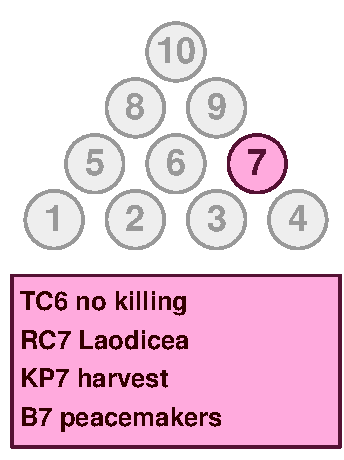
historical interpretation of the Seven Nodes of the Ten Pin model,
node 7 is the end of the age, the end of the kingdom of heaven. In this sense, both
"seventy" and
"seven" represent the end of the age. Thus resolves the problem of actually counting a literal
70 and then using opinion and conjecture to rationalize doing this literally
70 times.
21. Matthew 18:21-22
Matthew 18:21 Then came Peter to him, and said, Lord, how oft shall my brother sin against me, and I forgive him? till seven times? [kjv]
τοτε προσελθων αυτω ο πετρος ειπεν αυτω κυριε ποσακις αμαρτησει εις εμε ο αδελφος μου και αφησω αυτω εως επτακις [gnt]
… septies [v]
18:22 Jesus saith unto him, I say not unto thee, Until seven times: but, Until seventy times seven. [kjv]
λεγει αυτω ο ιησους ου λεγω σοι εως επτακις αλλ αλλα εως εβδομηκοντακις επτα [gnt]
… septies … septuagies septies [v]
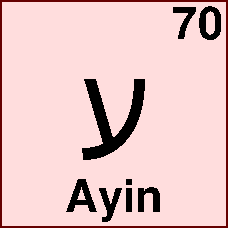
The
ancient Greek word
"εβδομήντα" ≈ "seventy".
The
ancient Greek word
"ἑβδομηκοντάκις" ≈ "seventy times/occurrences".
22. End of page