- *G2894 *6 κόφινος (kof'-ee-nos) : of uncertain derivation; a (small) basket:--basket.
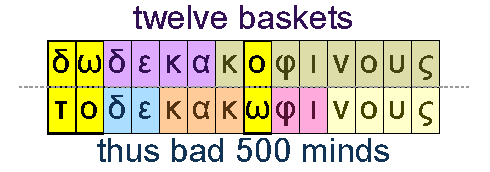
κοφινους *4
Matthew 14:20 ... of the fragments that remained twelve baskets full.
Matthew 16:9 ... of the five thousand, and how many baskets ye took up?
Mark 8:19 ... among five thousand, how many baskets full of fragments took ye up? ...
John 6:13 ... and filled twelve baskets with the fragments of the five ...
κοφινων
Mark 6:43 And they took up twelve baskets full of the fragments, and ...
κοφινοι
22. Matthew 14:20 Feeding and baskets
Matthew 14:20 And they did all eat, and were filled: and they took up of the fragments that remained twelve baskets full. [kjv]
και εφαγον παντες και εχορτασθησαν και ηραν το περισσευον των κλασματων δωδεκα κοφινους πληρεις [gnt]
… manducaverunt omnes … saturati … reliquias duodecim cofinos fragmentorum plenos [v]
The
Latin word
"cofinas" ≈ "basket, hamper" is a loan word from the
ancient Greek word
"κόφινος" ≈ "basket" and is the source of the English word (through French) of
"coffin".
23. Matthew 26:20 The number twelve
Matthew 26:20 Now when the even was come, he sat down with the twelve. [kjv]
οψιας δε γενομενης ανεκειτο μετα των δωδεκα μαθητων [gnt]
… efne … haelend … twelf … [wes]
… Abend setzte … Zwölfen. [lu]
The
ancient Greek word
"δώδεκα" ≈ "twelve" from the Greek words for "
two" and "
ten". The
Latin word
"duadecim" ≈ "twelve". The
modern Greek word
"δώδεκα" (THO-theh-ka) ≈ "twelve".
The
Old English word
"twelf" ≈ "twelve" comes from "
two" and "
left". That is, there are two left when ten is taken away. The word for "
left" meant the same thing as "
lacks". The English word
"twelve" is related to the
German word
"zwölf" ≈ "twelve".
Why would a joke about 12 eggs be boring?
Because it would make you a "dozen".
24. Matthew 14:20 Twelve baskets
25. Matthew 14:20
KJV: And they did all eat, and were filled: and they took up of the fragments that remained twelve baskets full.
Greek: και εφαγον παντες και εχορτασθησαν και ηραν το περισσευον των κλασματων δωδεκα κοφινους πληρεις
Latin: et manducaverunt omnes et saturati sunt et tulerunt reliquias duodecim cofinos fragmentorum plenos
26. Matthew 14:21
Matthew 14:21 And they that had eaten were about five thousand men, beside women and children. [kjv]
οι δε εσθιοντες ησαν ανδρες ωσει πεντακισχιλιοι χωρις γυναικων και παιδιων [gnt]
The context is after one of the feedings, here of 5,000 men not counting women and children.
Note that there are two feedings, each somewhat
different, to help prevent faulty generalizations except for deceptions using selective evidence, often for the purpose of deception.
Some pastors (and others) have done such misrepresentation using a specific basket in a specific feeding.
27. Matthew 14:21
KJV: And they that had eaten were about five thousand men, beside women and children.
Greek: οι δε εσθιοντες ησαν ανδρες ωσει πεντακισχιλιοι χωρις γυναικων και παιδιων
Latin: manducantium autem fuit numerus quinque milia virorum exceptis mulieribus et parvulis
28. Compare starting resources
Matthew 14:17 And they say unto him, We have here but five loaves, and two fishes. [kjv]
οι δε λεγουσιν αυτω ουκ εχομεν ωδε ει μη πεντε αρτους και δυο ιχθυας [gnt]
… quinque panes … duos pisces [v]
15:34 And Jesus saith unto them, How many loaves have ye? And they said, Seven, and a few little fishes. [kjv]
και λεγει αυτοις ο ιησους ποσους αρτους εχετε οι δε ειπον ειπαν επτα και ολιγα ιχθυδια [gnt]
… panes … septem … paucos pisciculos [v]
29. Compare command and ground
Matthew 14:19 And he commanded the multitude to sit down on the grass, and took the five loaves, and the two fishes, and looking up to heaven, he blessed, and brake, and gave the loaves to his disciples, and the disciples to the multitude. [kjv]
και κελευσας τους οχλους ανακλιθηναι επι τους χορτους και του χορτου λαβων τους πεντε αρτους και τους δυο ιχθυας αναβλεψας εις τον ουρανον ευλογησεν και κλασας εδωκεν τοις μαθηταις τους αρτους οι δε μαθηται τοις οχλοις [gnt]
… iussisset turbam discumbere supra faenum … quinque panibus … duobus piscibus … benedixit … fregit … panes … turbis [v]
15:35 And he commanded the multitude to sit down on the ground. [kjv]
και εκελευσεν τοις οχλοις παραγγειλας τω οχλω αναπεσειν επι την γην [gnt]
… praecepit turbae … discumberet super terram [v]
30. Compare blessing and thanks
Matthew 14:19 And he commanded the multitude to sit down on the grass, and took the five loaves, and the two fishes, and looking up to heaven, he blessed, and brake, and gave the loaves to his disciples, and the disciples to the multitude. [kjv]
και κελευσας τους οχλους ανακλιθηναι επι τους χορτους και του χορτου λαβων τους πεντε αρτους και τους δυο ιχθυας αναβλεψας εις τον ουρανον ευλογησεν και κλασας εδωκεν τοις μαθηταις τους αρτους οι δε μαθηται τοις οχλοις [gnt]
… iussisset turbam discumbere supra faenum … quinque panibus … duobus piscibus … benedixit … fregit … panes … turbis [v]
15:36 And he took the seven loaves and the fishes, and gave thanks, and brake them, and gave to his disciples, and the disciples to the multitude. [kjv]
και λαβων ελαβεν τους επτα αρτους και τους ιχθυας και ευχαριστησας εκλασεν και εδωκεν εδιδου τοις μαθηταις αυτου οι δε μαθηται τω οχλω τοις οχλοις [gnt]
… accipiens septem panes … pisces … gratias … fregit … populo [v]
31. Compare and Baskets and number
Matthew 14:20 And they did all eat, and were filled: and they took up of the fragments that remained twelve baskets full. [kjv]
και εφαγον παντες και εχορτασθησαν και ηραν το περισσευον των κλασματων δωδεκα κοφινους πληρεις [gnt]
… manducaverunt omnes … saturati … reliquias duodecim cofinos fragmentorum plenos [v]
15:37 And they did all eat, and were filled: and they took up of the broken meat that was left seven baskets full. [kjv]
και εφαγον παντες και εχορτασθησαν και ηραν το περισσευον των κλασματων ηραν επτα σπυριδας σφυριδας πληρεις [gnt]
… saturati … fragmentis … septem sportas plenas [v]
32. Compare Number fed
Matthew 14:21 And they that had eaten were about five thousand men, beside women and children. [kjv]
οι δε εσθιοντες ησαν ανδρες ωσει πεντακισχιλιοι χωρις γυναικων και παιδιων [gnt]
… quinque milia … exceptis … [v]
15:38 And they that did eat were four thousand men, beside women and children. [kjv]
οι δε εσθιοντες ησαν τετρακισχιλιοι ανδρες χωρις γυναικων και παιδιων [gnt]
… quattuor milia … extra … [v]
33. Matthew 14:17,20-21 Verses
Matthew 14:17 And they say unto him, We have here but five loaves, and two fishes. [kjv]
οι δε λεγουσιν αυτω ουκ εχομεν ωδε ει μη πεντε αρτους και δυο ιχθυας [gnt]
14:20 And they did all eat, and were filled: and they took up of the fragments that remained twelve baskets full. [kjv]
και εφαγον παντες και εχορτασθησαν και ηραν το περισσευον των κλασματων δωδεκα κοφινους πληρεις [gnt]
14:21 And they that had eaten were about five thousand men, beside women and children. [kjv]
οι δε εσθιοντες ησαν ανδρες ωσει πεντακισχιλιοι χωρις γυναικων και παιδιων [gnt]
34. Matthew 14:17,20-21 By the numbers
Matthew 14:17 And they say unto him, We have here but five loaves, and two fishes. [kjv]
14:20 And they did all eat, and were filled: and they took up of the fragments that remained twelve baskets full. [kjv]
14:21 And they that had eaten were about five thousand men, beside women and children. [kjv]
Five loaves and two fishes.
Twelve (small) baskets left.
Five thousand (men) fed.
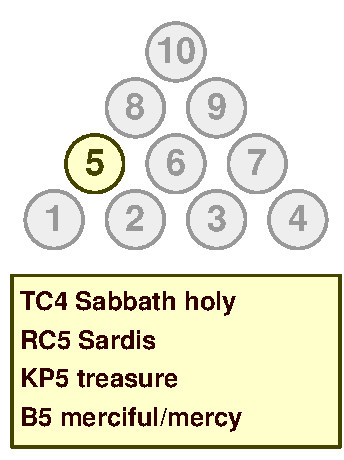
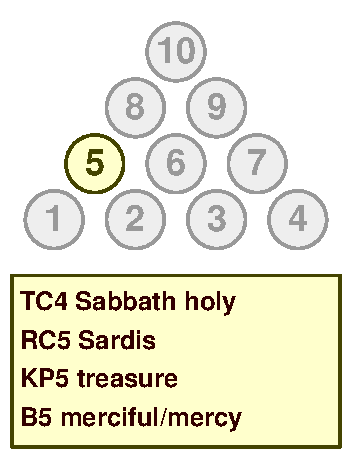
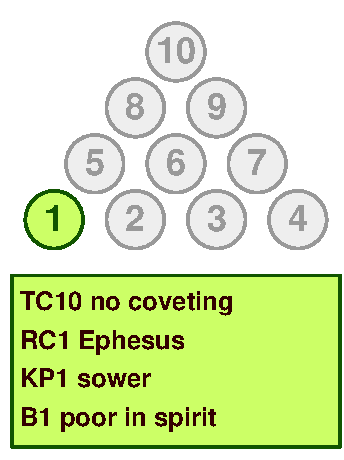
Ten Pin node 12 corresponds to node 5.
Jesus commanded (not announced) to sit on the grass (not earth/sand).
Jesus gives blessed (not thanked).
35. Compare feedings: all ten differences
 |
| # |
Matthew 14:13‑21 |
Matthew 15:29‑39 |
| 1 |
five [mourning] loaves |
seven [on those] loaves |
| 2 |
two [of God] fish |
a few [wolves]
small fish [snakes] |
| 3 |
commanded |
announced |
| 4 |
recline |
fall down |
| 5 |
grass |
earth/sand |
| 6 |
looking into heaven |
|
| 7 |
blessed (good word) |
gave thanks |
| 8 |
twelve (small) |
seven (large) |
| 9 |
baskets [coffins] |
baskets (for money) |
| 10 |
five thousand fed |
four thousand fed |
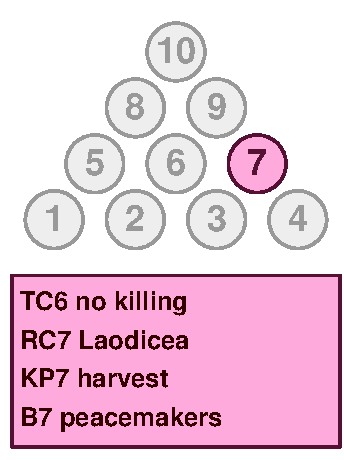
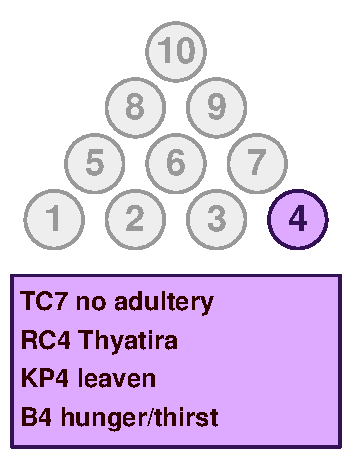
| Ten Pin connection |
|
Node 5/12 |
Nodes 4 & 7 |
|
Abba vineyard |
Rome vineyard |
|
 |
36. Statistical probability
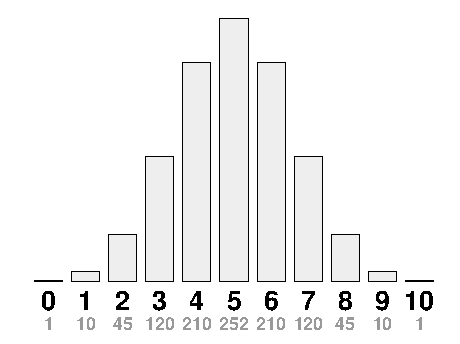
If each of the ten factors has an equal chance of being expressed either way, the probability that all would go one way or the other is that of 0 of 10 or 10 of 10. That is 1 l 1024 or about one chance in a thousand.
This can be modeled with a binomial distribution.
Of course, it could just be a
coincidence.
37. Matthew 5:45 Under the weather
Matthew 5:45 That ye may be the children of your Father which is in heaven: for he maketh his sun to rise on the evil and on the good, and sendeth rain on the just and on the unjust. [kjv]
οπως γενησθε υιοι του πατρος υμων του εν ουρανοις οτι τον ηλιον αυτου ανατελλει επι πονηρους και αγαθους και βρεχει επι δικαιους και αδικους [gnt]
The Greek word translated as "
be" is that of "
coming into being".
The "sun" rises on the "evil" or "oppressive" and the "good". Are these opposites?
It "rains" on the "just" and the "unjust". These are, by definition, opposites.
At the end of the Sermon on the Mount, the "
rain" will fall on
both the "
house" built on the "
rock" and the "
house" built on "
sand". Only
one will
fall.
Jesus will speak many verses having to do with "
evil" and "
good". Are these
opposites?
Note:
"βροχή" ≈ "rain" GNT.
"κλοπή" ≈ "theft".
"βρέχω" ≈ "wet, drench, rain".
"βρόχος" ≈ "noose, snare (for birds)"
38. Matthew 5:45
Matthew 5:45 That ye may be the children of your Father which is in heaven: for he maketh his sun to rise on the evil and on the good, and sendeth rain on the just and on the unjust. [kjv]
οπως γενησθε υιοι του πατρος υμων του εν ουρανοις οτι τον ηλιον αυτου ανατελλει επι πονηρους και αγαθους και βρεχει επι δικαιους και αδικους [gnt]
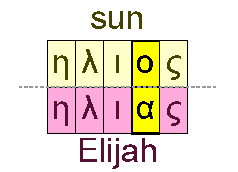
"ἥλιος" ≈ "sun, east, day, sunshine"
"Ἠλίας" ≈ "Elijah".
Since Jesus associates
John the Baptist with
Elijah, it is interesting to see how Jesus uses the word for "
sun".
Elijah was taken away in a chariot of fire.
... sends the sun [call to repentance, think after, through the John connection] on the oppressive and the good ...
... and rain [theft] on the righteous and unrighteous.
39. End of page