Send
Close Add comments:
(status displays here)
Got it! This site "www.creationpie.org" uses cookies. You consent to this by clicking on "Got it!" or by continuing to use this website. Note: This appears on each machine/browser from which this site is accessed.
Sunday School 2026-09-13 Matthew: Jesus and flipping the bird perception 2
1. Sunday School 2026-09-13 Matthew: Jesus and flipping the bird perception 2
2026-09-13: Combined service. No photos. Content stream only.
2. Starting soon ...
☐ Start OBS Stream to YTC.
☐ Check Edge JavaScript.
☐ Check RSIV auto grab.
☐ Check OBS audio levels.
☐ Check OBS window output (wide/narrow).
☐ Start OBS
Record and YTS
Go Live.
3. Welcome
4. Matthew: Jesus and flipping the bird perception 2
This content is being developed.
5. Matthew: Jesus and flipping the bird perception 2
In the Greek New Testament in Matthew, Jesus does not use the many Greek words for a bird in a good sense. Instead, Jesus uses play on words on birds, and even bird sounds, such that a bird represents the religious false leader/teacher who, in the name of Jesus, deceives and uses (oppresses as in evil) others for personal gain. This flips the common and popular perception of birds in the sayings of Jesus.
This content is a continuation of those references with links to more details on each individual reference.
6. Birdhouses
7. Proverbs 1:17 Birds and nets
Proverbs 1:17 Surely in vain the net is spread in the sight of any bird. [kjv]
ου γαρ αδικως εκτεινεται δικτυα πτερωτοις [lxx]
for nets are not without cause spread for birds. [bs3]
The
Epistle of Barnabas interprets
birds and
nets from Proverbs 1:17 in the
LXX (Septuagint). Both use the Greek word for
"bird" that emphasizes the "
wing".
A bird net works much better if there is some food on which the birds desire to eat. It might be "
deceptive" food.
English: Now the scripture says: "Not unjustly are nets spread out for the birds". This means that people deserve to perish if, having knowledge of the way of righteousness, they ensnare themselves in the way of darkness. (1.4, Holmes, p. 393)
Greek: [1.4] λέγει δὲ ἡ γραφή Οὐκ ἀδίκως ἐκτείνεται δίκτυα πτερωτοῖς. τοῦτο λέγει, ὅτι δικαιως ἀπολεῖται ἄνθρωπος, ὃς ἔχων ὁδοῦ δικαιοσύνης γνῶσιν ἑαυτὸν εἰς ὁδὸν σκότους ἀποσυνέχει.
8. Turtle doves are not turtles
Song of Solomon 2:12 The flowers appear on the earth; the time of the singing of birds is come, and the voice of the turtle is heard in our land; [kjv]
τα ανθη ωφθη εν τη γη καιρος της τομης εφθακεν φωνη του τρυγονος ηκουσθη εν τη γη ημων [lxx]
flores apparuerunt … tempus putationis advenit … turturis audita … terra nostra [v]
What sound does a
"turtle" make? A
"turtle dove" is a type of bird called a "
dove" or "
pigeon". The Latin word
"turturum" ≈ "turtle doves" comes from the onomatopoeic words
"tur, tur" as the sound made by these birds.
The Latin word "turtla" ≈ "male turtle dove".
The Latin word "turtle" ≈ "female turtle dove".
The word
"turtle" was influenced by
"turtle dove" but the two creatures are quite different.
9. Matthew 7:6 Play on words
Matthew 7:6 Give not that which is holy unto the dogs, neither cast ye your pearls before swine, lest they trample them under their feet, and turn again and rend you. [kjv]
μη δωτε το αγιον τοις κυσιν μηδε βαλητε τους μαργαριτας υμων εμπροσθεν των χοιρων μηποτε καταπατησωσιν καταπατησουσιν αυτους εν τοις ποσιν αυτων και στραφεντες ρηξωσιν υμας [gnt]
[monastery fumigation]
|
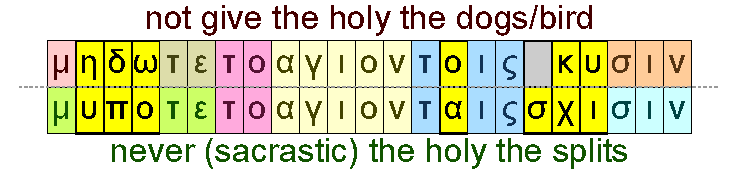
English: not give the holy the dogs/bird
Greek: μη δωτε το αγιον τοις κυσιν
Greek: μηποτε το αγιον ταις σχισιν
English: never (sarcastic) the holy the splits
|
The ancient Greek word
"κῐ́σσαιν" ≈ "jay bird" (dative) and
"κίσσα" ≈ "jay bird" or, in context,
"longing of pregnant women",
"craving for strange food".
10. Matthew 23:24 Camels and apples
Matthew 23:24 Ye blind guides, which strain at a gnat, and swallow a camel. [kjv]
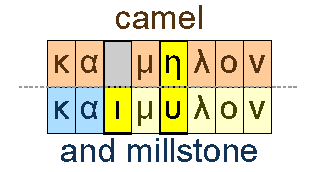
οδηγοι τυφλοι οι διυλιζοντες τον κωνωπα την δε καμηλον καταπινοντες [gnt]
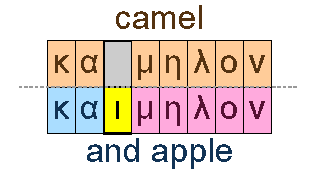
"κάμηλον" ≈ "camel" (accusative).
"και" ≈ "and".
"μῆλον" ≈ "apple" (accusative).
"μύλον" ≈ "millstones" (accusative).
The Romans liked
"apples" (from 300 BC) and were known for their tasty and colorful "
red" apples. Had collaboration with Rome, as in the apple of discord, by the religious establishment, became a millstone around the neck of the Jewish people?
Why is it a female camel?
11. Matthew 23:24 Ozzie the camel
Matthew 23:24 Ye blind guides, which strain at a gnat, and swallow a camel. [kjv]
οδηγοι τυφλοι οι διυλιζοντες τον κωνωπα την δε καμηλον καταπινοντες [gnt]
Has anyone heard of Ozzie the (baby) camel at the Pretzel Hut?
12. Matthew 23:24 Put it together
Matthew 23:24 Ye blind guides, which strain at a gnat, and swallow a camel. [kjv]
οδηγοι τυφλοι … διυλιζοντες τον κωνωπα την δε καμηλον καταπινοντες [gnt]
English: strain the gnat the of/which the camel swallow
Greek: διυλιζοντες τον κωνωπα την δε κάμηλον καταπινοντες (as written)
Greek: δια λιζοντες τον κωνο πετεινα και μυλόν καταπινοντες (play on words)
English: through the matter/play the cone/hemlock/poison birds and apple swallow
The flexible Greek word order is sometimes used to create a play on words that adds the imagery and meaning to the actual words.
Had the religious establishment in Judea attempted to "
swallow" the "
poison" and/or "
blood" of the (Roman) "
birds" and "
apple"? There are other ways that the play on words could create mental imagery.
The Greek for "
gnat" is the source of the English word
"canopy".
13. Matthew 23:12 Exalt and humble
Matthew 23:12 And whosoever shall exalt himself shall be abased; and he that shall humble himself shall be exalted. [kjv]
οστις δε υψωσει εαυτον ταπεινωθησεται και οστις ταπεινωσει εαυτον υψωθησεται [gnt]
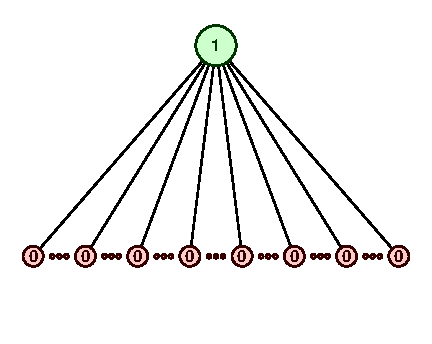
Does this mean that we are all (or will be) at the same level?
The
KJV (King James Version) translates as
"abased" and then
"humble" the Greek word that means
"humble".
The use of
"humble" in the above verse is used as opposites. That is, the
KJV "abased" (lowered, as in status) is the Greek
"humbled", just as Greek uses similar roots for "
exalt" and "
exalted".
Wycliffe uses the Middle English word
"mekith" ≈ "humbled" which is
"make meek" as
"meeketh".
14. Bird denial play on words
15. Matthew 10:33 Denial of Jesus
Matthew 10:33 But whosoever shall deny me before men, him will I also deny before my Father which is in heaven. [kjv]
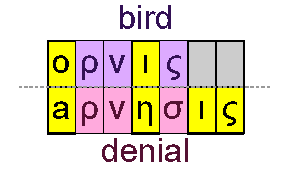
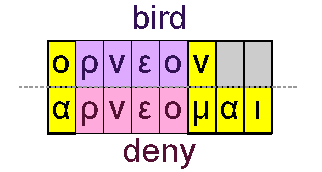
The play on words is that of
"deny" with
"bird" (behavior).
Paraphrase:
Whoever denies me before men, I will deny him before my Father in heaven.
Play on words:
Whoever [bones, hostile] denies [birds] me before men, I will deny [bird] him before my Father in heaven.
So Jesus will use the
reasoning of the
"bird" who
"denies" Jesus by not "
knowing" Jesus. Does Jesus ever say that he does
not "
know" someone?
16. Psalms 124:7 Escape the net
Psalms 124:7 Our soul is escaped as a bird out of the snare of the fowlers: the snare is broken, and we are escaped. [kjv]
η ψυχη ημων ως στρουθιον ερρυσθη εκ της παγιδος των θηρευοντων η παγις συνετριβη και ημεις ερρυσθημεν [lxx]
If you can see through the deception, you can escape the snare.
17. Prisoners
The best way to keep a prisoner from escaping is to make sure he never knows he's in prison. Fyodor Dostoevsky (1821-1881), author of
Crime and punishment.
Russian name: Фёдор Михайлович Достоевский (1821-1881)
Analogy:
The best way to keep people separated (rooted up, loosed, judged) from the love of Christ is to not let them know they have separated themselves from the love of Christ. One way:
Convince the people that nothing can separate them from the love of Christ. Therefore, they do not need to worry about anything.
Many are "
happy" in the "
abyss", "
pit", "
ditch", "
wide area" as in
better/bitter together,
all in the same boat/vote, etc.
Discuss: Has has the modern cell phone become a prison? Is there a tribulation pressure? How about peer pressure?
18. Cardinals
The English word
"cardinal" comes, through French, from the Latin word
"cardinalis" ≈ "pertaining to a hinge" which comes from
"cardo" ≈ "hinge". You would not want to be "
unhinged"!
It is interesting that that the word "
cardinal" is the name of a "
bird". Early European settlers in North America were reminded of the red robes and hats worn by Roman Catholic cardinals which provided the name for the "
cardinal" "
bird".
Jesus does not use the idea of a
"bird" in a good sense. The Greek word for
"bird" is a play on words with the Greek word for
"deny".
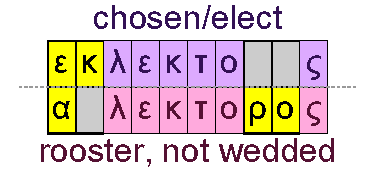
19. Chosen roosters
20. Matthew 22:14 Many called few chosen
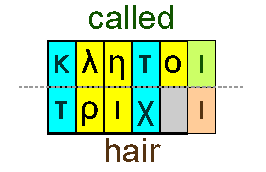
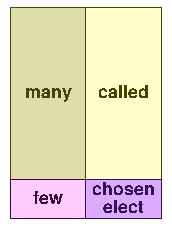
Matthew 22:14 For many are called, but few are chosen. [kjv]
πολλοι γαρ εισιν κλητοι ολιγοι δε εκλεκτοι [gnt]
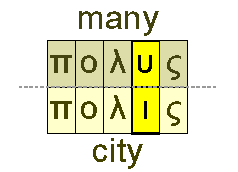
Of the
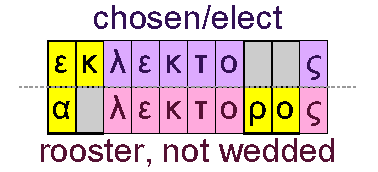
"many" called in the Parable of the Wedding Feast, only
one is
"chosen" to go into "
outer" "
darkness".
Paraphrase:
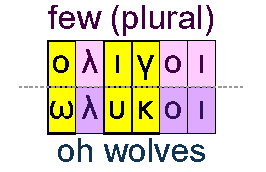
Many [city] are called [hairs] but few [O wolves] are chosen [roosters].
How
"many" is
"many"? How
"few" is
"few"?
21. Thank you
22. End of page