Send
Close Add comments:
(status displays here)
Got it! This site "www.creationpie.org" uses cookies. You consent to this by clicking on "Got it!" or by continuing to use this website. Note: This appears on each machine/browser from which this site is accessed.
TenWordPin overview
1. TenWordPin overview
This content is being developed.
2. TenWordPin overview
This is an overview and introduction to the background of the TenWordPin model.
... more to be added ...
3. Ideas
Ideas to be added.
user interface decisions and viewpoints
handling ambiguity
4. An introduction to Bible truth
5. Bible truth, God and the universe
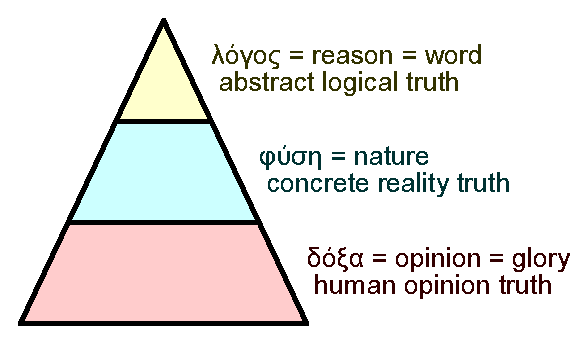
How can one show that the Bible is true? That it reflects reality? And in a logical way?
The following commonly cited reasons are important but not logically valid.
inerrancy (assumed), infallibility (assumed)
preserved manuscripts
eye witness testimony
changed lives
if not liar or lunatic then Lord (C. S. Lewis, used later by Josh McDowell on college campuses)
These all leave something lacking.
6. Greek truth as reality
7. Hebrew truth as reality
Genesis 2:3 And God blessed the seventh day, and sanctified it: because that in it he had rested from all his work which God created and made. [kjv]
… אלהים … בראאלהיםלעשות [he]
In Genesis 2:3, the end of the verse says that God rested from his work which "
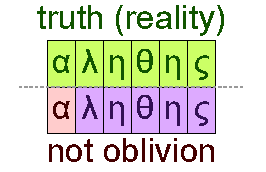
God created and made". This is the basis for the Hebrew word for truth which, like the Greek word for truth, «
αλήθεια», has to do with the reality of our world.
The Hebrew word for truth, "
אמת" has the first letter of the Hebrew alphabet at the beginning, the middle letter near the middle, and the last letter at the end.
8. Knowledge of the truth
2 Timothy 3:7 Ever learning, and never able to come to the knowledge of the truth. [kjv]
παντοτε μανθανοντα και μηδεποτε εις επιγνωσιν αληθειας ελθειν δυναμενα [gnt]

This verse appears to describe some academic professors (especially those without any real world experience in what they are teaching). Note the double negative in Greek, as most of the world outside of English are accustomed to using double negatives for emphasis.
"
Ever learning, and never able to come to the knowledge of the truth" reminds one of the Penrose steps (made famous by Escher as elaborations on the theme).
The English word "mathematics" comes from the Greek «μάθημα» which means "learning".
The English word "science" comes from the Latin "scientiam" which means "knowledge".
9. Truth types: logic, reality, opinion
The word "
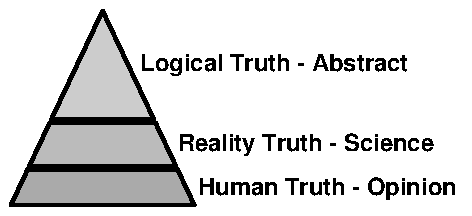
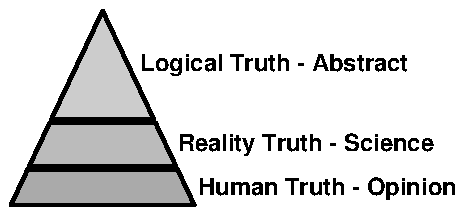
truth" has a wide range of meanings. For the present purposes, the following are considered levels of truth.
Logical truth: abstract symbol manipulation
Reality truth: traditional science from facts and models
Human truth: opinions and everything else
These areas can overlap but the distinction is, nonetheless, useful. Human opinion truth may or may not be connected to reality truth and/or logical truth.
10. Genesis 1:1 Declarative models and causal reasoning
Genesis 1:1 In the beginning God created the heaven and the earth. [kjv]
בראשיתבראאלהים … השמים … הארץ [he]
εν αρχη εποιησεν ο θεος τον ουρανον και την γην [lxx]
Genesis 1 is a
declarative model of creation and not a
procedural or
imperative model of creation. It says
what happened but not exactly
how it happened.
Word processors are declarative - WYSIWYG (What You See Is What You Get).
Microsoft Word is "What you see is what you hope to get".
Spreadsheets are declarative (a simple functional language).
Programming languages such as C, C++, Java, Python, etc., are imperative or procedural.
11. Models and reality
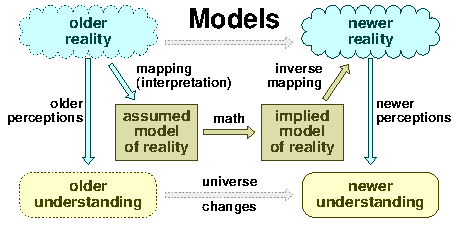
A
model is an
abstraction (
interpretation) of
reality that can be used for prediction and/or understanding.
Given new information or insight, a
model can be enhanced and/or refined over time.
Multiple models: Duality.
Essentially, all models are wrong, but some are useful. George Box, Statistician.
The best material model of a cat is another, or preferably the same, cat. Norbert Wiener (and A. Rosenblueth).
A model is a
useful fiction. Some would try to declare a model
guilty by pointing out places where the model does not fit (fact check fallacy).
If the model fits, you must acquit! (paraphrase from a famous legal case).
12. Textus Receptus and model breaking
The
TR (Textus Receptus) often adds or changes (or removes) words that break a model of the underlying passage. Detecting this requires recognizing that a model exists and then how that model is broken with the changes.
Recognizing models or patterns help establish the semantic meaning of the passage in a fault-tolerant error-correcting way such that changes to the text that break the model or pattern become more evident.
This content is a start at consolidating some examples of this model-breaking in the
GNT (Greek New Testament).
NA28, Nestle-Aland 28 (Novum Testamentum Graece) to NIV (converse error)
TR to KJV (and back, so appears to match since TR often changed to match KJV)
Byzantine has a few differences to NA28
... more to be added ...
13. Divide and conquer: Top-down and bottom-up
A divide and conquer problem solving method starts with a goal.
The problem is broken down in a top-down or backward-chaining manner as part of the solution design.
The solution is implemented in a bottom-up or forward-chaining manner as part of the solution implementation.
At each point in the implementation, unit testing is added for each part and abstractions made as needed.
14. Top-down vs. bottom-up
The use of top-down backward-chaining thinking and logic in problem solving is essential to computer science thinking.
C if B if A (top-down backward chaining)
A then B then C (bottom-up, forward chaining)
Most other people use bottom-up forward-chaining thinking and logic and problem solving which is, in most cases, not the best way. The most common problems with this way of thinking is that the goal may not be clear, one may not get to the goal, one may deviate from the goal, and one may do extra work in trying to get to the goal.
15. John 1:1-19 Top-down Gospel message
The bottom-up, forward chaining is used by most people. But not by John. He uses top-down, backward-chaining reasoning. The beginning of the Gospel of John is written in a top-down backward chaining way.
16. John 21:24-25 Giving way to the gospel writing style of John
In theory, a well-written computer program has nothing in it that is not needed. Everything is important in some way. Any change may make the program stop working. In reality, there are times that code is left in programs that is not really needed but it takes time to take it out, etc.
[junk DNA, redundancy for fault tolerance]
If John were writing as a computer scientist, then everything John writes would be important in some way. Anything not needed would have been omitted. The logic presented does not need to be in chronological order nor include extra detail.
John actually says this but many people miss the point. To fully understand, an important word needs to be covered after covering the other words in this verse.
17. 1 John 1:1-10 Top down purpose of life
Have you ever read 1 John 1:1-10 (the complete chapter)? It can be confusing. I have heard many pastors try to explain it in bits and pieces.
What is the purpose of life? In an explanation that is similar to that used by computer scientists,
John, in 1 John 1:1-10, provides a
top-down backward-chaining step-by-step line of reasoning that reaches the following
conclusion.
1 John 1:3 That which we have seen and heard declare we unto you, that ye also may have fellowship with us: and truly our fellowship is with the Father, and with his Son Jesus Christ. [kjv]
18. Names
19. John 19:19-22 Languages on the cross
John 19:19 And Pilate wrote a title, and put it on the cross. And the writing was, JESUS OF NAZARETH THE KING OF THE JEWS. [kjv]
εγραψεν δε και τιτλον ο πιλατος και εθηκεν επι του σταυρου ην δε γεγραμμενον ιησους ο ναζωραιος ο βασιλευς των ιουδαιων [gnt]
19:20 This title then read many of the Jews: for the place where Jesus was crucified was nigh to the city: and it was written in Hebrew, and Greek, and Latin. [kjv]
τουτον ουν τον τιτλον πολλοι ανεγνωσαν των ιουδαιων οτι εγγυς ην της πολεως ο τοπος της πολεως οπου εσταυρωθη ο ιησους και ην γεγραμμενον εβραιστι ελληνιστι ρωμαιστι ελληνιστι [gnt]
We get the English word
"title" from the Latin
"titulum" and the Greek «
τιτλον». The term for "
Latin" in the Latin Vulgate appears in John as the language of the
"Romans". Latin was the language of the Romans. As was usual, Pilate had an inscription placed above Jesus on the cross, signifying his crime.
A written language can refer to itself or to other languages.
20. Introduction: the Greek language
The Greek language has a long history going back about 3,000 years. During this time, there have been many variants of the Greek language (e.g. originally Attic, Doric, Ionic, etc.), but over the years there have been periodic attempts to take Greek back to its roots, so that many words from 2,500 years ago are still in common use, or at least recognized as part of the modern language.
21. Natural Language Parsing examples
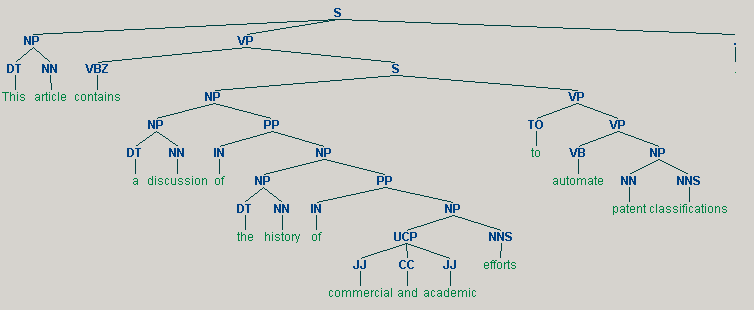 NLP (Natural Language Processing)
software systems including
POS (Part of Speech) analysis, can be used to attempt to automatically analyze unstructured text.
To stimulate ideas, here is some output from some available
NLP and
POS systems.
The default settings were used. There are many ways to customize and tweak the system depending on the domain of application.
22. Natural language parsing
23. Some difficulties of language translation

Modern automatic language translations systems, such as Google Translate, use machine learning and statistical pattern matching rather than language grammar and spelling rules and specific knowledge of the languages being translated.
So, for example, the Greek word for "
well", as in a "
hole in the ground", might go through English to get translated into Russian as "
well", as in "
very good".
24. The languages spoken by Jesus and the disciples
Matthew 18:3 And said, Verily I say unto you, Except ye be converted, and become as little children, ye shall not enter into the kingdom of heaven. [kjv]
There are various schools of though on whether Jesus spoke Aramaic or Greek. Most educated people in the Roman Empire studied and spoke Latin, Greek and a native language in their area of birth or location, such as Aramaic in Judea.
Many in Judea grew up speaking both from birth. It is likely that Jesus and the disciples knew and spoke both Aramaic and Greek and, perhaps, some Latin. Few could read Hebrew and it was no longer spoken.
Living language: Spoken by children without formal reading and writing, grammar, spelling, etc.
Dead language: Not spoken by children as in not living.
25. Selected parts of speech
This content contains tables of selected parts of speech.
The color coding for these tables change as different combinations are tested.
... more to be added ...
26. Communication security and authentication
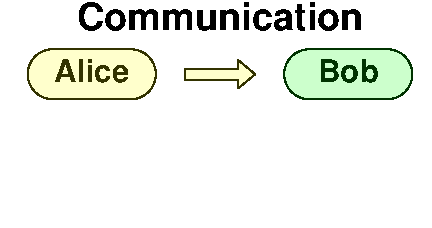
The classic communication scenario has
A sending a message to
B. Usually,
A is chosen as
Alice who is sending a message to
B who is chosen as
Bob.
The primary security issues that can arise include the following.
eavesdropping
man in the middle attack
spoofing
27. Inside security threats
It is often said that 80% of security problems come from inside and not outside the organization.
A malicious insider is someone inside the company who is a non-cooperating user. This type of user is very dangerous because the entire system depends on cooperating users inside the system.
28. The security of flaming swords
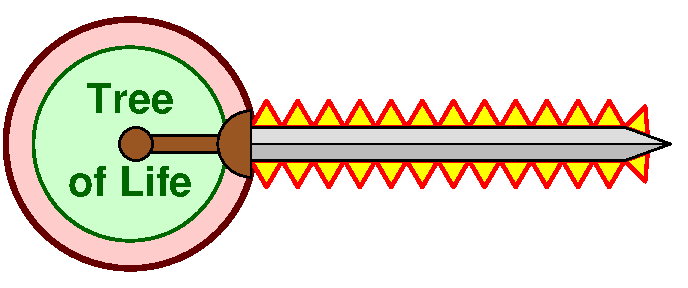
Genesis 3:24 So he drove out the man; and he placed at the east of the garden of Eden Cherubims, and a flaming sword which turned every way, to keep the way of the tree of life. [kjv]
και εξεβαλεν τον αδαμ και κατωκισεν αυτον απεναντι του παραδεισου της τρυφης και εταξεν τα χερουβιμ και την φλογινην ρομφαιαν την στρεφομενην φυλασσειν την οδον του ξυλου της ζωης [lxx]
… Adam … paradisum voluptatis … flammeum gladium … custodiendam viam ligni vitae [v]
A
key or password provides
passive security to protect a resource.
Active security requires a physical presence of someone or something guarding the resource. Is it a
"tree" or a big stick of
"wood" or
"timber"? How about a
"torch"?
Is the security of the
"flaming" "sword" in Genesis 3:24 "
active", "
passive", both or none of these? Is that
"flaming" "sword" needed to keep access open, to keep access closed, both of these, none of these, or something else? [piece of wood vs. tree as code word]
29. Paul and puns
30. Punishment by Spoonerisms: switched consonants
A
Spoonerism, named for William
Spooner (1844-1930), switches consonants of words. Vowels can often be pronounced such as to sound similar.
It is kisstomary to cuss the bride.
The Lord is a shoving leopard.
Mardon me padam, This pie is occupewed. Please sew me to another sheet.
| shake a tower |
take a shower |
| runny babbit |
bunny rabbit |
| fight a liar |
light a fire |
From the comedy group
Capitol Steps (1980's):
Resident Pagan (President Reagan).
The same effect can be achieved in many languages, including Greek. [Caesar using Greek to encrypt Latin]
31. Punishment by mondegreens: misheard lyrics
A
mondegreen is pun consisting of a misheard lyric or verse that sounds like something other than what was written.
The term "
mondegreen" was coined by
Sylvia Wright in 1954 who as a child had heard the poem line "
laid him on the green" as "
Lady Mondegreen".
Here are some hymn titles or lines that are mondegreens.
Gladly, the cross-eye bear
Come on oh kinky turtle
Andy walks with me
Bringing in the sheets
A maze of grapes, how sweet and round
How late though art (for the Spring time change)
While shepherds washed their socks by night
32. Punishment by punny puns
Luke 6:21 Blessed are ye that hunger now: for ye shall be filled. Blessed are ye that weep now: for ye shall laugh. [kjv]
μακαριοι οι πεινωντες νυν οτι χορτασθησεσθε μακαριοι οι κλαιοντες νυν οτι γελασετε [gnt]
A
pun is a play on words or double meaning for a word or phrase. Some people love puns. Some people hate puns. There are many puns, or play on words, used in Hebrew (and Greek) in the Bible. Most puns are by sound, some by meaning, etc.
33. Genesis 1:1-31 Pinning hopes on a tentative weak creation model
Genesis 1:1 In the beginning God created the heaven and the earth. [kjv]
בראשיתבראאלהים … השמים … הארץ [he]
The story of the
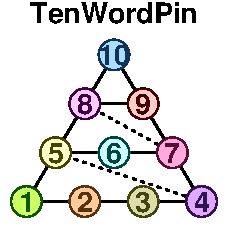
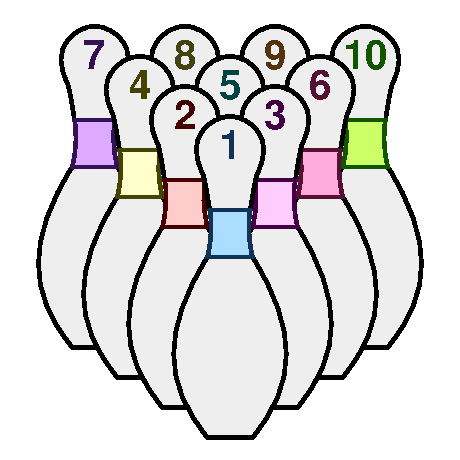
creation week in Genesis appears to fit the TenWordPin model in some interesting ways. Let us look at each day of the creation week in Genesis 1.
For ten (10) elements, there are
10! (ten factorial) or
3,628,800 ways or
permutations of arranging those elements.
Some of these ways make more sense than other ways in terms of a model.
34. Exodus 20:3-17 TenWordPin model
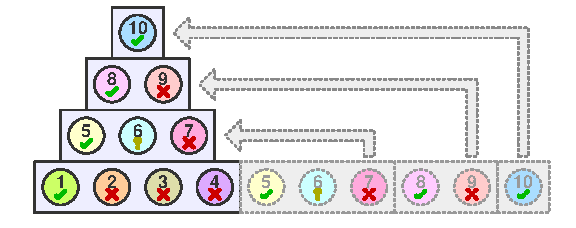
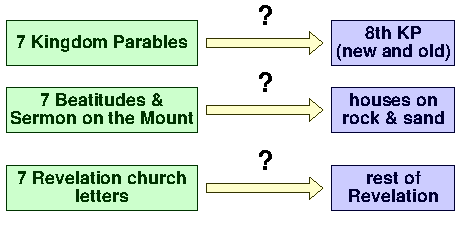
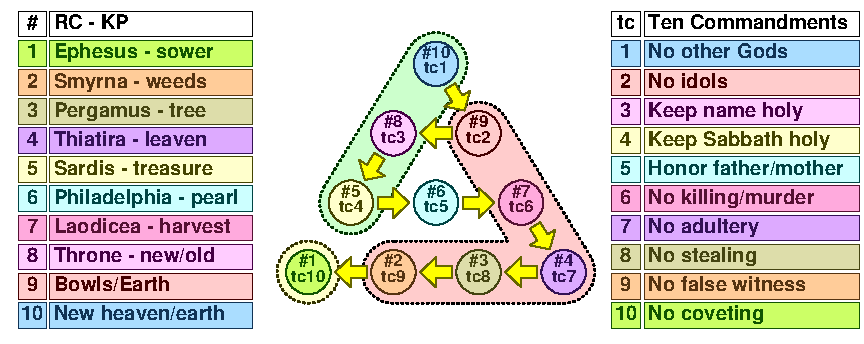
How do the follow-on parts of the Kingdom Parables, the Sermon on the Mount, and the Letters to the Churches in Revelation, follow from the main part of each?
A model is presented for that answers these questions (and more).
Letters to the seven churches in Revelation.
The kingdom parables in Matthew 13.
The Beatitude that starts the Sermon on the Mount in Matthew 5.
The Sermon on the Mount in Matthew 5-7.
Once the model is presented, the Ten Commandments appear to fit that model in a nice way.
35. Sermon on the Mount: TenWordPin verse model
The birds:
2. Deceive (
lie) with opinions (
weeds).
3. Recruit (
steal) followers (
tree).
4. Recruit (
adultery) leaders (
leaven).
Matthew 5:1-2 Introduction of Jesus and disciples on the mountain, the crowd down further away.
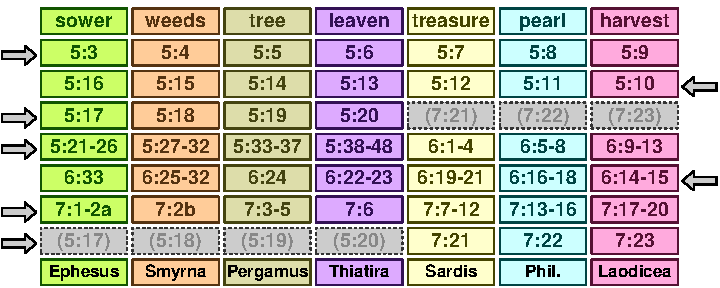
Matthew 5:3 to 7:23 Body of the Sermon an the mount (103 verses).
Matthew 7:24-27 Summary of the house on rock and house on sand.
Matthew 7:28-29 Commentary after the Sermon on the Mount.
[spread spectrum communication]
Here are some more connections in the Sermon on the Mount. The 103 verses that form the body of the Sermon on the Mount form six sequences of seven ideas that match rather well the Kingdom Parables and the Seven Churches in Revelation. Some sequences are top-down backward-chaining while others are bottom-up forward-chaining.
36. TenWordPin model nodes
The TenWordPin model combines many parts of the
GNT and
LXX (Septuagint) (as found in the
HOT (Hebrew Old Testament)) in a way that can be used to explain many parts that previously had been explained only by opinion using selected patterns in selected areas, etc.
This content continues with application of that mode to other verses and parts of the Bible.
37. TenWordPin history
This is a start at a history of the TenWordPin model. Many additional passes are needed over this material to flesh it out with more details. Some parts need to be reordered. And so on.
... more to be added ...
38. Computer science fundamentals
Counting (off by one, one cookies rule)
39. Computer science topics
Fixed points
Modus ponens and modus tolens
DeMorgan's laws, compound logical expressions/questions
Information and statistics
CS vs. SE vs. IS vs. IT
Architecture in place: tighten screws.
40. End of page