Send
Close Add comments:
(status displays here)
Got it! This site "www.creationpie.org" uses cookies. You consent to this by clicking on "Got it!" or by continuing to use this website. Note: This appears on each machine/browser from which this site is accessed.
Shibboleth: how something is said
1. Similarity of the R and L sounds
2. Sounds difficult to pronounce
Every group of people appear to have sounds that are difficult for them to pronounce.
"th" in Russian ("theater" can sound like "te-a-ter", "ruth" as "roof")
What is such a sound in English?
3. Sound difficult in English
The Greek letter «
ξ» (ski) is pronounced as "
ks". Try pronouncing the following.
ksee-ros
ksee-roks
ksee-los
Note the "
ks" sound at the start of a word (in English).
4. Greek Ski and English X
The Greek «
ξ» went into Latin as the letter "
X".
In English:
An "X" at the beginning of a word is pronounced as "z".
An "X" at the end of a word is pronounced as "ks" as in "box".
Here are some examples:
ksee-ros for "dry"
ksee-roks for "Xerox" as in a dry printing/copying process and has the «ξ» at both the beginning and the end of the word.
ksee-los for "wood" as in "xylophone", a musical instrument with (originally) wooden bars struck by a mallet to sound musical notes.
5. Shibboleth: how something is said
Judges 12:6 Then said they unto him, Say now Shibboleth: and he said Sibboleth: for he could not frame to pronounce it right. Then they took him, and slew him at the passages of Jordan: and there fell at that time of the Ephraimites forty and two thousand. [kjv]
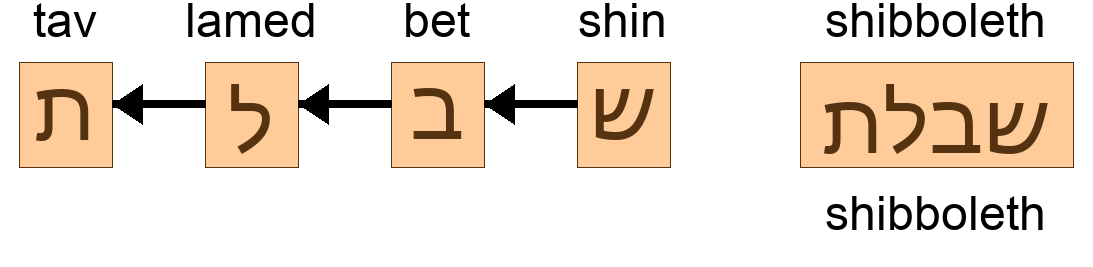
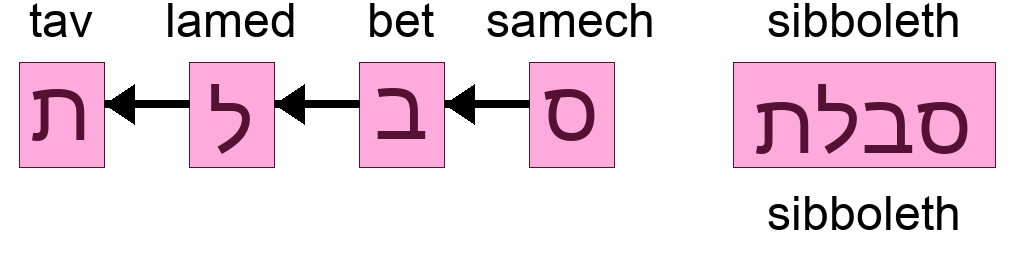
… שבלת … סבלת … [he]
Originally, from the book of Joshua in the
OT (Old Testament), a
"shibboleth" was a sound that a particular group of people have trouble pronouncing and that was used as a form of audible password or authentication mechanism in battle of identifying "
friend" or "
foe", that is, an
IFF (Identify Friend or Foe) system.
Today, the meaning has been generalized to be any sound that distinguishes a group of people.
6. Judges 12:5-6 Original usage
Judges 12:5 And the Gileadites took the passages of Jordan before the Ephraimites: and it was so, that when those Ephraimites which were escaped said, Let me go over; that the men of Gilead said unto him, Art thou an Ephraimite? If he said, Nay; [kjv]
… לא [he]
12:6 Then said they unto him, Say now Shibboleth: and he said Sibboleth: for he could not frame to pronounce it right. Then they took him, and slew him at the passages of Jordan: and there fell at that time of the Ephraimites forty and two thousand. [kjv]
και ειπαν αυτοις ειπατε δη συνθημα και ου κατηυθυναν του λαλησαι ουτως και επελαβοντο αυτων και εσφαξαν αυτους επι τας διαβασεις του ιορδανου και επεσαν εξ εφραιμ εν τω καιρω εκεινω δυο τεσσαρακοντα χιλιαδες [lxx]
… שבלת … סבלת … [he]
The term
"shibboleth" originated in Judges 12:5 during the conquest of the promised land by Joshua. If the answer was "
yes", the identity was obvious. If he said
"no", a
code word was needed to distinguish friend from foe.
7. Judges 12:5
KJV: And the Gileadites took the passages of Jordan before the Ephraimites: and it was so, that when those Ephraimites which were escaped said, Let me go over; that the men of Gilead said unto him, Art thou an Ephraimite? If he said, Nay;
Hebrew: וילכד גלעד את מעברות הירדן לאפרים והיה כי יאמרו פליטי אפרים אעברה ויאמרו לו אנשי גלעד האפרתי אתה ויאמר לא׃
Greek: και προκατελαβοντο ανδρες γαλααδ τας διαβασεις του ιορδανου του εφραιμ και εγενηθη οτι ειπαν οι διασεσωσμενοι του εφραιμ διαβωμεν και ειπαν αυτοις οι ανδρες γαλααδ μη υμεις εκ του εφραιμ και ειπαν ουκ εσμεν
Latin: occupaveruntque Galaaditae vada Iordanis per quae Ephraim reversurus erat cumque venisset ad ea de Ephraim numero fugiens atque dixisset obsecro ut me transire permittas dicebant ei Galaaditae numquid Ephrateus es quo dicente non sum
Wycliffe: And the men of Galaad ocupieden the forthis of Jordan, bi whiche Effraym schulden turne ayen. And whanne a man fleynge of the noumbre of Effraym hadde come to tho forthis, and hadde seid, Y biseche, that thou suffre me passe; men of Galaad seiden to hym, Whether thou art a man of Effraym? And whanne he seide, Y am not,
8. Judges 12:6
KJV: Then said they unto him, Say now Shibboleth: and he said Sibboleth: for he could not frame to pronounce it right. Then they took him, and slew him at the passages of Jordan: and there fell at that time of the Ephraimites forty and two thousand.
Hebrew: ויאמרו לו אמר נא שבלת ויאמר סבלת ולא יכין לדבר כן ויאחזו אותו וישחטוהו אל מעברות הירדן ויפל בעת ההיא מאפרים ארבעים ושנים אלף׃
Greek: και ειπαν αυτοις ειπατε δη συνθημα και ου κατηυθυναν του λαλησαι ουτως και επελαβοντο αυτων και εσφαξαν αυτους επι τας διαβασεις του ιορδανου και επεσαν εξ εφραιμ εν τω καιρω εκεινω δυο τεσσαρακοντα χιλιαδες
9. Hebrew: shibboleth and sibboleth
The word
"shibboleth" literally means a stream, ear of grain, branch, etc. Note the difference between the "
sh" sound in the Hebrew "
ש" (shin) and the "
s" sound in the Hebrew "
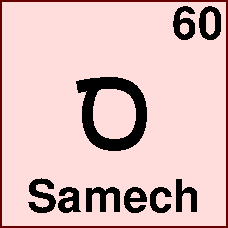
ס" (samech).
10. Security term
In the security field:
Shibboleth is a single sign-on (log-in) system for computer networks and the Internet. It allows people to sign in using just one identity to various systems run by federations of different organizations or institutions.
11. Matthew 12:11 Grab with power
Matthew 12:11 And he said unto them, What man shall there be among you, that shall have one sheep, and if it fall into a pit on the sabbath day, will he not lay hold on it, and lift it out? [kjv]
ο δε ειπεν αυτοις τις εσται εξ υμων ανθρωπος ος εξει προβατον εν και εαν εμπεση τουτο τοις σαββασιν εις βοθυνον ουχι κρατησει αυτο και εγερει [gnt]
The ancient Greek word
"κρατέω" ≈ "rule, conquer, seize, hold" and provides the last part of the English word
"democracy".
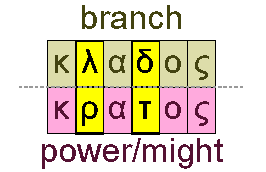
"κλάδος" ≈ "branch".
"κράτος" ≈ "might, strength" which is source of the word "democracy" which means "power of the people".
The Greek word for
"branch" is a play on words with "
power" or "
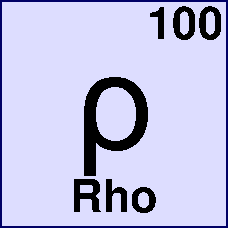
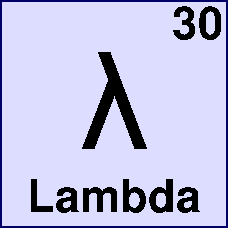
might". Linguistically, the liquid "
R" and "
L" are similar. Compare:
"fried rice" and "flied lice" (Letter similarity).
"light fires" and "fight liars" (Spoonerism).
12. Punishment by Spoonerisms: switched consonants
A
Spoonerism, named for William
Spooner (1844-1930), switches consonants of words. Vowels can often be pronounced such as to sound similar.
It is kisstomary to cuss the bride.
The Lord is a shoving leopard.
Mardon me padam, This pie is occupewed. Please sew me to another sheet.
| shake a tower |
take a shower |
| runny babbit |
bunny rabbit |
| fight a liar |
light a fire |
From the comedy group
Capitol Steps (1980's):
Resident Pagan (President Reagan).
The same effect can be achieved in many languages, including Greek. [Caesar using Greek to encrypt Latin]
13. End of page