- *G1381 *23 δοκιμάζω (dok-im-ad'-zo) : from G1384; to test (literally or figuratively); by implication, to approve:--allow, discern, examine, X like, (ap-)prove, try.
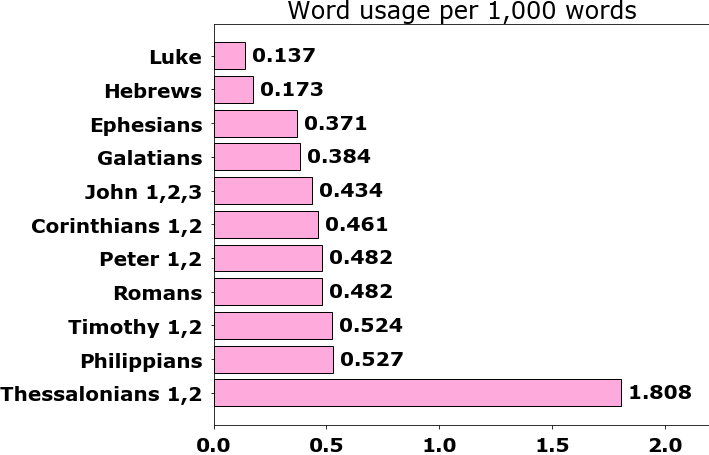
δοκιμαζετε *4
Luke 12:56 Ye hypocrites, ye can discern the face of the sky and of the earth; but how is it that ye do not discern ...
2 Corinthians 13:5 ... ye be in the faith; prove your own selves. Know ye not ...
1 Thessalonians 5:21 Prove all things; hold fast that which is good.
1 John 4:1 ... every spirit, but try the spirits whether they are ...
δοκιμαζειν *3
Luke 12:56 Ye hypocrites, ye can discern the face of the sky and of the earth; but how is it that ye do not discern ...
Romans 12:2 ... mind, that ye may prove what is that good, ...
Philippians 1:10 That ye may approve things that are excellent; that ye may be ...
δοκιμαζετω *2
1 Corinthians 11:28 But let a man examine himself, and ...
Galatians 6:4 But let every man prove his own work, ...
δοκιμασαι
Luke 14:19 ... of oxen, and I go to prove them: I pray thee ...
εδοκιμασαν
δοκιμαζεις
Romans 2:18 And knowest his will, and approvest the things that are more excellent, being instructed out of the law;
δοκιμαζει
δοκιμασει
δοκιμασητε
1 Corinthians 16:3 And when I come, whomsoever ye shall approve by your letters, them ...
δοκιμαζων
2 Corinthians 8:8 ... of the forwardness of others, and to prove the sincerity of your love.
εδοκιμασαμεν
2 Corinthians 8:22 ... brother, whom we have oftentimes proved diligent in ...
δοκιμαζοντες
δεδοκιμασμεθα
1 Thessalonians 2:4 But as we were allowed of God to be put in trust with the gospel, even so we speak; not as pleasing men, but God, which trieth our hearts.
δοκιμαζοντι
1 Thessalonians 2:4 But as we were allowed of God to be put in trust with the gospel, even so we speak; not as pleasing men, but God, which trieth our hearts.
δοκιμαζεσθωσαν
1 Timothy 3:10 And let these also first be proved; then let them use the office of a deacon, ...
δοκιμασια
Hebrews 3:9 ... fathers tempted me, proved me, and saw ...
δοκιμαζομενου
1 Peter 1:7 ... that perisheth, though it be tried with fire, might be found ...
12. Matthew 16:3 Discerning the weather
Matthew 16:3 And in the morning, It will be foul weather to day: for the sky is red and lowring. O ye hypocrites, ye can discern the face of the sky; but can ye not discern the signs of the times? [kjv]
και πρωι σημερον χειμων πυρραζει γαρ στυγναζων ο ουρανος υποκριται το μεν προσωπον του ουρανου γινωσκετε διακρινειν τα δε σημεια των καιρων ου δυνασθε δυνασθε [gnt]
The
KJV translates as the first "
discern" the Greek word that means
"know" (in depth).
The
KJV translates as the second "
discern" the Greek word that means
"through separation" as in
"discern". [Aristotle and meteorology]
Most translations (omitted) use the same word for the two (different) Greek words.
How would you describe a meteorologist who cannot make up his or her mind?
Under the whether from a cloudy mind.
13. Luke 12:56 Prove
Luke 12:56 Ye hypocrites, ye can discern the face of the sky and of the earth; but how is it that ye do not discern this time? [kjv]
υποκριται το προσωπον της γης και του ουρανου οιδατε δοκιμαζειν τον δε καιρον δε τουτον πως ου δοκιμαζετε ουκ οιδατε δοκιμαζειν [gnt]
… probare … probatis [v]
… preue … preuen … [wy]
… prüfen… prüfet … [lu]
Matthew uses the more abstract word for "
examination (to deceive)" as an intellectual exercise (in deception) with associated play on words.
Luke uses the more literal word for
"trying out",
"testing out", etc., with corresponding loss of the play on word meaning. How does one "
test out" the face of the sky?
14. Luke 12:56
KJV: Ye hypocrites, ye can discern the face of the sky and of the earth; but how is it that ye do not discern this time?
Greek: υποκριται το προσωπον της γης και του ουρανου οιδατε δοκιμαζειν τον δε καιρον δε τουτον πως ου δοκιμαζετε ουκ οιδατε δοκιμαζειν
Latin: hypocritae faciem terrae et caeli nostis probare hoc autem tempus quomodo non probatis
Wycliffe: Ypocritis, ye kunnen preue the face of heuene and of erthe, but hou preuen ye not this tyme.
Luther: Ihr Heuchler, die Gestalt der Erde und des Himmels könnt ihr prüfen, wie prüfet ihr aber diese Zeit nicht?
15. Contradiction
A
contradiction is something that is inconsistent with assumptions up to the point when the contradiction is reached.
To prove a proposition
p by proof by contradiction,
The proposition p must be either true or false.
Assume p to be false (i.e., not true).
Show a contradiction (that is, p cannot be false).
The conclusion is that the original assumption p must be true.
This is the method used by the logic programming language Prolog.
16. Three errors puzzle
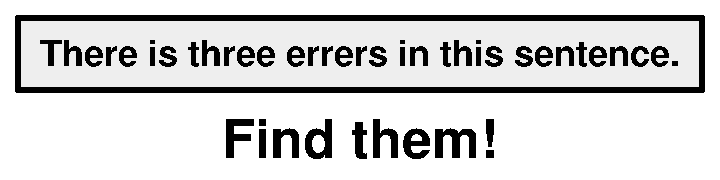
What is not there may be important?
Consider this self-referential sentence that has real issues. First, find them. Then ask yourself the following question. How easy is it to fix them?
[basketball story]
17. Proof names
18. Examples
Here are some well-known examples.
Euclid: Infinity of primes.
Pythagoras: Irrationality of the square root of 2.
Turing: Halting Problem.
There are many others.
19. Proofs by contradiction
A proof by contradiction assumes the opposite of something as true, then shows that that assumed opposite is not true (or does not work as expected), which means that the original something must be true (or works as expected).
20. Logic
It is desired to prove proposition P.
Assume that P is false, that is not P.
Show that not P implies false.
This shows that assuming not P leads to a contradiction so that P must be true.
21. Aristotle
An original argument in formal terms goes back to Aristotle, described here. A few centuries earlier, Xenophanes of Colophon describes the argument in a poem. After Aristotle, Euclid and Archimedes both use the technique. Socrates and Plato, before Aristotle, use the technique in dialectical (discussion) format. The Sorites paradox is related to this technique.
Aristotle calls this "
demonstration"
"into" the
"impossible".
The Latin word "per" ≈ "through, by means of".
It is not clear if Aristotle wants the following compared.
"Sophistic" "refutations". Latin: "sophismata refutandi" ≈ "sophistic refutations".
"Demonstration" "into" the "impossible". Latin: "demonstratio ad impossibile" ≈ "demonstration to the impossible".
22. Logic: syllogisms
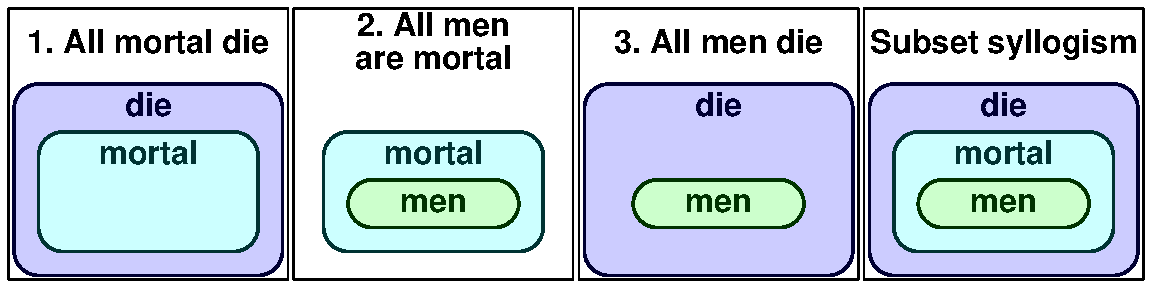
Logical reasoning in Greek
philosophy often took the form of a
syllogism that uses deductive reasoning to arrive at a conclusion.
Some people think syllogisms are "
silly" and will use the pun "
sillygism" to refer to a "
syllogism".
23. Fill the grid problem
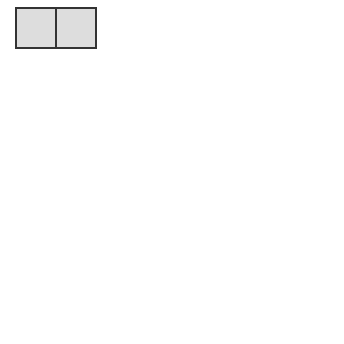
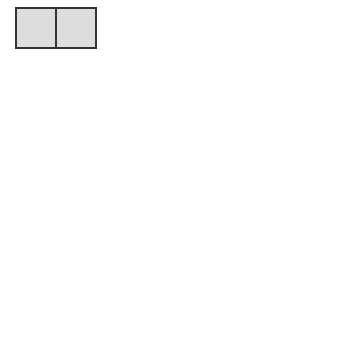
You are given an
8 by
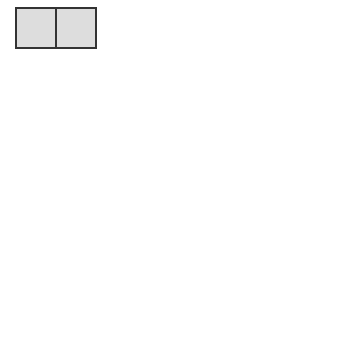
8 grid. You are completely fill the grid with bricks, each
2 by
1, or prove (show) that it cannot be done. No overlapping bricks. All bricks used must be on the grid. This is easy to prove (show) by demonstration.
Aristotle's explanation of "
demonstration" "
into" the "
impossible" can be difficult to explain and understand using his logic system and proof rules of syllogisms. The
fill the grid problem will be used to explain the essence of Aristotle's method.
Aside: I started using this problem as part of the problem solving part of introductory computer science courses in the late 1980's.
24. Fill the grid problem
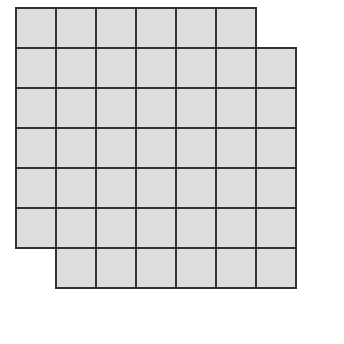
You are now given an
8 by
8 grid two opposite corners removed. You are to either completely fill the grid with bricks, each
2 by
1, or prove (show) that it cannot be done. No overlapping bricks. All bricks used must be on the grid.
Proving that something cannot be done is "
impossible" using Aristotle's method of syllogisms. Thus, one must "
go away (from)" "
into" the "
impossible" by going outside the system of syllogisms by
assuming it can be done and then finding a
contradiction.
Assume or agree that the bricks can fill the grid.
Find a contradiction. If found, there is agreement that it cannot be done.
Aside: The Greek word for "
agree" (going both ways) is the word often translated as "
confess" (going one way) in the
GNT (Greek New Testament).
25. Fill the grid problem
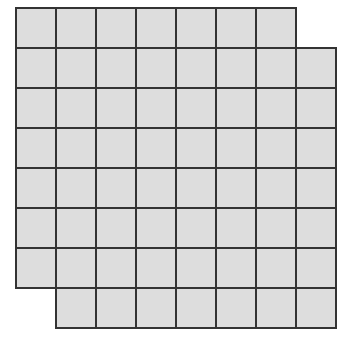
You are now given a
7 by
7 grid with two opposite corners removed. You are to either completely fill the grid with bricks, each
2 by
1, or prove (show) that it cannot be done. No overlapping bricks. All bricks used must be on the grid.
One can use the same method for this problem.
Assume or agree that the bricks can fill the grid.
Find a contradiction. If found, there is agreement that it cannot be done.
Hint: The
contradiction in this problem is not the same
contradiction as the previous problem.
26. Outline
Aristotle developed syllogisms as a way to use logic to show that certain propositions were true. This system does not work well, in general, for showing that propositions are false. Here is an outline of the method described by Aristotle.
We can show that syllogism A: p1 and p2 is true. This is a obstensive proof.
We agree that syllogism B: p1 and p3 is false but cannot prove it.
We negate p3 and show that syllogism C: p1 and (not p3) is true and, thus, has contradictions. This is an obstensive proof.
We conclude, using "proof" "into" the "impossible" that syllogism B is false. The name "proof" "into" the "impossible" appears to come from step B - the step that is to be proven false and is "impossible" to prove using syllogisms. Steps A and C are normal syllogisms.
Thus, the solution goes "away from" B as "into the impossible" and thus, towards C.
27. Outline
Note that since the result is mechanically obtained from the expression or formula of the syllogism, they can be considered as one entity.
| A: |
p1 and p2 |
true |
obstensive proof (standard syllogism) |
| B: |
p1 and p3 |
assumed false |
proof into the impossible |
| C: |
p1 and (not p3) |
true |
obstensive proof (standard syllogism) |
Note that the problem solution requires that the expression (
not p3) be simplified before solving the syllogism.
28. Aristotle: Prior Analytics
English: Proof per impossible differs from obstensive proof in that the former posits that which it intends to refute by reducing it to an admitted fallacy, whereas the latter proceeds from admitted positions. Both indeed assume two admitted premises. (Loeb#325, p. 473)
Greek: Διαφέρει δ' ἡ εἰς τὸ ἀδύνατον ἀπόδειξις τῆς δεικτικῆς τῷ τιθέναι ὃ βούλεται ἀναιρεῖν ἀπάγουσα εἰς ὁμολογούμενον ψεῦδος· ἡ δὲ δεικτικὴ ἄρχεται ἐξ ὁμολογουμένων θέσεων. λαμβάνουσι μὲν οὖν ἀμφότεραι δύο προτάσεις ὁμολογουμένας· Aristotle: Prior Analytics [62b]
English: Demonstration per impossible differs from probative demonstration in that it posits that it wishes to refute by reduction to a statement admitted to be false: whereas probative demonstration starts from admitted positions. Both, indeed, take two propositions that are admitted… (Barnes, p. , 100, 1984)
The translator (top), Hugh Tredennick (1939), takes liberties both with the word order and the meanings of some words. This may be because of not fully understanding the technical and logical argument being made by Aristotle.
[published logarithmic tables of the 1800's]
29. Aristotle: Prior Analytics
"ἀναιρέω" ≈ "take away, cancel, answer" translated as "refute"
"ἀπάγουσα" ≈ "leads away from" translated as "reducing" or "reduction".
"εἰς" ≈ "into" sometimes translated as "per" (Latin tradition).
"ὁμολογούμενον" ≈ "agreed (on)" translated as "admitted" and often translated as "confessed".
"ψεῦδος" ≈ "falsehood" and the prefix of English words starting with "pseudo".
An
expression (that expresses a value)
reduces from a combined form to a simpler form.
2+3 reduces 5 (the reduced value).
5 does not reduce to 2+3 (a combined form with parts). In functional programming languages (and programming language theory) one can abstract 5 to 2+3 (and many similar values). Deciding on which abstraction to use is important for a given problem being solved.
30. Combined ideas
| A: |
p1 and p2 |
true |
obstensive proof (standard syllogism) |
| B: |
p1 and p3 |
assumed false |
proof into the impossible |
| C: |
p1 and (not p3) |
true |
obstensive proof (standard syllogism) |
English: Proof per impossible differs from obstensive proof in that the former posits that which it intends to refute by reducing it to an admitted fallacy, whereas the latter proceeds from admitted positions. Both indeed assume two admitted premises. (Loeb#325, p. 473)
Paraphrase using table: Proof B,
"into" the
"impossible", is
different from proof A (and C) in that B asserts what it claims to refute/cancel by
"leading away from" "into" that assumed
fallacy or
false result (B, which cannot be proven using syllogisms).
Both A and C admit (agree to) two (valid) syllogism requirements (
p1,
p2,
not p3). (B does not).
What is
"impossible" here? What is
"impossible" is solving B as a syllogism. Thus, one must
"lead away from" "into" the
"impossible" (that is, B), and (instead) to C, which can be solved as a syllogism.
31. Aristotle: Prior Analytics
One idea:
In a constructive/obstensive proof, one reduces A to B. Thus, the expression (that expresses a value) reduces from 2+3 to 5 (the reduced value) and not from 5 to 2+3.
In a demonstration proof "into" the "impossible" one goes away from "into" B thus towards showing that A cannot be true.
32. Aristotle: Prior Analytics
English: but whereas the latter assumes those from which the syllogism proceeds, the former assumes one of these and one which is the contradictory of the conclusion; (Loeb#325, p. 473)
Greek: ἀλλ' ἡ μὲν ἐξ ὧν ὁ συλλογισμός, ἡ δὲ μίαν μὲν τούτων, μίαν δὲ τὴν ἀντίφασιν τοῦ συμπεράσματος. καὶ ἔνθα μὲν οὐκ ἀνάγκη γνώριμον εἶναι τὸ συμπέρασμα, οὐδὲ προϋπολαμβάνειν ὡς ἔστιν ἢ οὔ· ἔνθα δὲ ἀνάγκη ὡς οὐκ ἔστιν. Aristotle: Prior Analytics [62b]
This is the follow-on part by Aristotle (not needed here).
33. Statistics
Hypothesis testing in statistics is similar to proof by contradiction in mathematics.
... more to be added ...
34. Philippians 2:3 Lowliness of mind
Philippians 2:3 Let nothing be done through strife or vainglory; but in lowliness of mind let each esteem other better than themselves. [kjv]
μηδεν κατα κατ εριθειαν η μηδε κατα κενοδοξιαν αλλα τη ταπεινοφροσυνη αλληλους ηγουμενοι υπερεχοντας εαυτων [gnt]
That is, one is not deferring on the validity of valid or invalid (eristic and argumentative) logical arguments.
It may be necessary, as Paul does, to state a viewpoint in order to not give the impression that one is condoning a certain viewpoint.
Plainly (boldly) state the truth from the Bible.
Do not get into contentious arguments with those not of the truth.
What would happen if "
in highness of mind, let each esteem himself or herself better than others"?
35. End of page


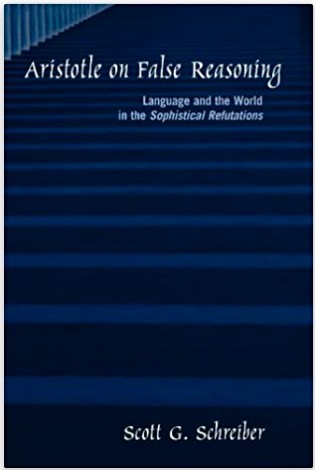 On page 2, Schreiber elaborates on "peirastic" reasoning as distinguished by Aristotle.