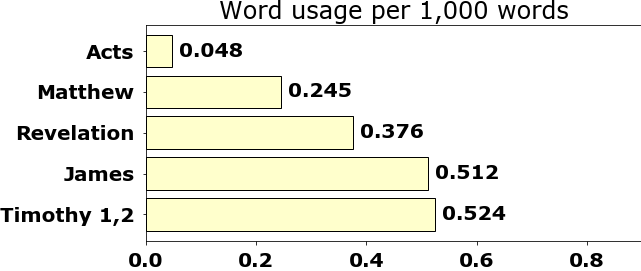
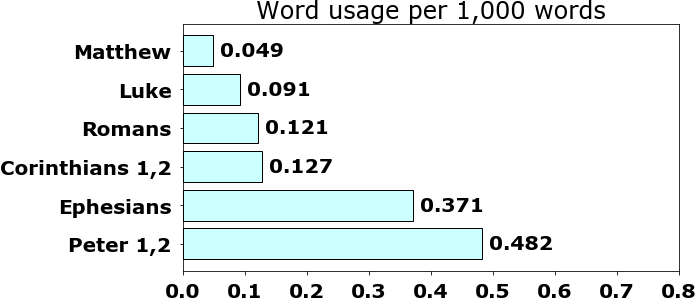
- *G5543 *7 χρηστός (khrase-tos') : from G5530; employed, i.e. (by implication) useful (in manner or morals):--better, easy, good(-ness), gracious, kind.
- χρηστος *4
- Matthew 11:30 For my yoke is easy, and my burden ...
- Luke 5:39 ... he saith, The old is better.
- Luke 6:35 ... for he is kind unto the unthankful and to the evil.
- 1 Peter 2:3 If so be ye have tasted that the Lord is gracious.
- χρηστον
- Romans 2:4 ... longsuffering; not knowing that the goodness of God leadeth thee ...
- χρηστα
- 1 Corinthians 15:33 ... evil communications corrupt good manners.
- χρηστοι
- Ephesians 4:32 And be ye kind one to another, ...
9. Romans 16 A belly-ache pun on useful Christ-like words
Romans 16:18 For they that are such serve not our Lord Jesus Christ, but their own belly; and by good words and fair speeches deceive the hearts of the simple. [kjv]
οι γαρ τοιουτοι τω κυριω ημων ιησου χριστω ου δουλευουσιν αλλα τη εαυτων κοιλια και δια της χρηστολογιας και ευλογιας εξαπατωσιν τας καρδιας των ακακων [gnt]
Near the end of Romans, Paul says that false teachers, to support their "
belly", will use
"useful words" to
deceive the overly-trusting congregation or, literally, "
not bad". Paul makes a pun between
"Christ" and
"useful"
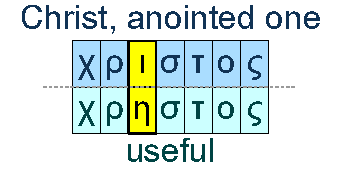
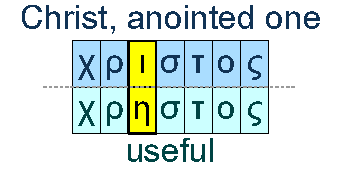
The ancient Greek word "χρηστός" ≈ "useful". What is the "use" of the words?
The ancient Greek word "χριστός" ≈ "anointed one".
In modern Greek these words have the same meaning and are pronounced the same.
The modern Greek word "χρηστός" (hree-STOS) ≈ "useful" where "useful".
The modern Greek word "χριστός" (hree-STOS) ≈ "Christ, anointed one" .
In ancient times, there was a small difference in how they sounded.
10. Sweet sermons in Latin
Romans 16:18 For they that are such serve not our Lord Jesus Christ, but their own belly; and by good words and fair speeches deceive the hearts of the simple. [kjv]
οι γαρ τοιουτοι τω κυριω ημων ιησου χριστω ου δουλευουσιν αλλα τη εαυτων κοιλια και δια της χρηστολογιας και ευλογιας εξαπατωσιν τας καρδιας των ακακων [gnt]
The Latin has "
sweet sermons" for "
good words" and "
benedictions" for "
fair speeches". The Latin word
"dulco" ≈ "sweet".
The ancient Greek word
"εὐλογία" ≈ "good speaking, flattery" and is the source of the English word
"eulogy".
11. Easter: Shape and prophecy of the cross
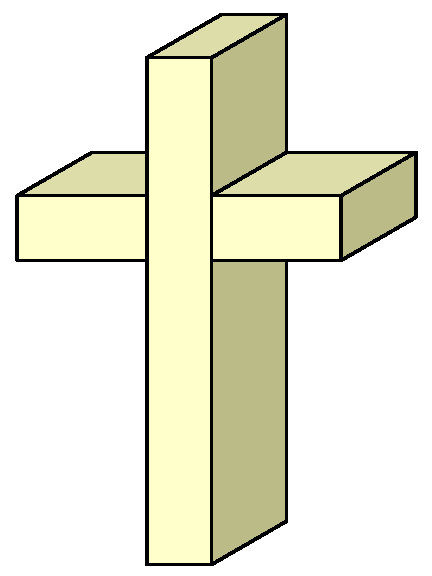
What was the actual shape of the crucifixion cross?
Some interesting connections arise when the cross has the shape of a "
tee" or "
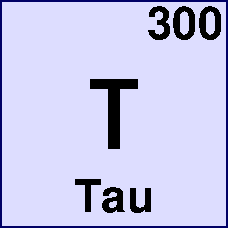
T" as in Greek letter "
τ" or "
Τ" (tau) as related by Barnabas and some other Roman writers. The impression of the traditional shape could come from the addition of a "
title" (and supporting piece) placed above to describe the crime.
"χριστός" ≈ "Christ" as in "anointed one".
"χρηστός" ≈ "useful" and appears as a play on words by both Jesus and Paul.
"χρυσός" ≈ "gold".
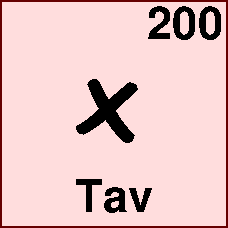
In particular, in Greek, if the "
t" or "
tau" or "
cross" is removed from "
Christ" one gets a play on words of "
gold". This may or may not have significance.
12. Matthew 23:16
Matthew 23:16 Woe unto you, ye blind guides, which say, Whosoever shall swear by the temple, it is nothing; but whosoever shall swear by the gold of the temple, he is a debtor ! [kjv]
ουαι υμιν οδηγοι τυφλοι οι λεγοντες ος αν ομοση εν τω ναω ουδεν εστιν ος δ αν ομοση εν τω χρυσω του ναου οφειλει [gnt]
In ancient times, one might take an "
oath" or "
vow". The ancient Greek word
"ὅρκος" ≈ "oath" as in the "
object by which one swears" and is related to
"ἕρκος" ≈ "fence". This "
swear" (verb) is not the same Greek word as "
oath" (noun) but is a semantic match in that they have the same meaning.
This Greek word is related to the shoulder as in "
swear" (verb) as «
ωμοσεαν» whereas the word «
ορκον» (noun) is used for the "
oath".
13. Matthew 23:17 Fools
Matthew 23:17 Ye fools and blind: for whether is greater, the gold, or the temple that sanctifieth the gold? [kjv]
μωροι και τυφλοι τις γαρ μειζων εστιν ο χρυσος η ο ναος ο αγιαζων αγιασας τον χρυσον [gnt]
Jesus uses the idea of "
greater" in terms of
"gold" and the "
temple".
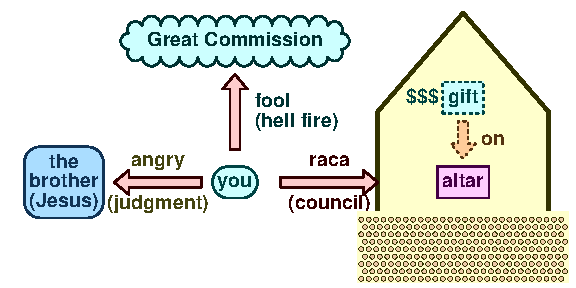
Jesus calls the religious elite
"fools" or, in Aramaic, "
raca". Is Jesus then "
liable" or in "
danger" of the "
council"? He will be at the crucifixion.
14. Matthew 23:18-19
Matthew 23:18 And, Whosoever shall swear by the altar, it is nothing; but whosoever sweareth by the gift that is upon it, he is guilty. [kjv]
και ος εαν αν ομοση εν τω θυσιαστηριω ουδεν εστιν ος δ αν ομοση εν τω δωρω τω επανω αυτου οφειλει [gnt]
23:19 Ye fools and blind: for whether is greater, the gift, or the altar that sanctifieth the gift? [kjv]
μωροι και τυφλοι τυφλοι τι γαρ μειζον το δωρον η το θυσιαστηριον το αγιαζον το δωρον [gnt]
15. Matthew 23:20-22
Matthew 23:20 Whoso therefore shall swear by the altar, sweareth by it, and by all things thereon. [kjv]
ο ουν ομοσας εν τω θυσιαστηριω ομνυει εν αυτω και εν πασιν τοις επανω αυτου [gnt]
23:21 And whoso shall swear by the temple, sweareth by it, and by him that dwelleth therein. [kjv]
και ο ομοσας εν τω ναω ομνυει εν αυτω και εν τω κατοικουντι αυτον [gnt]
23:22 And he that shall swear by heaven, sweareth by the throne of God, and by him that sitteth thereon. [kjv]
και ο ομοσας εν τω ουρανω ομνυει εν τω θρονω του θεου και εν τω καθημενω επανω αυτου [gnt]
16. Revelation 1:12-13
Revelation 1:12 And I turned to see the voice that spake with me. And being turned, I saw seven golden candlesticks; [kjv]
και επεστρεψα βλεπειν την φωνην ητις ελαλησεν ελαλει μετ εμου και επιστρεψας ειδον επτα λυχνιας χρυσας [gnt]
1:13 And in the midst of the seven candlesticks one like unto the Son of man, clothed with a garment down to the foot, and girt about the paps with a golden girdle. [kjv]
17. Revelation 1:12
KJV: And I turned to see the voice that spake with me. And being turned, I saw seven golden candlesticks;
Greek: και επεστρεψα βλεπειν την φωνην ητις ελαλησεν ελαλει μετ εμου και επιστρεψας ειδον επτα λυχνιας χρυσας
18. Revelation 1:13
KJV: And in the midst of the seven candlesticks one like unto the Son of man, clothed with a garment down to the foot, and girt about the paps with a golden girdle.
Greek: και εν μεσω των επτα λυχνιων ομοιον υιω υιον ανθρωπου ενδεδυμενον ποδηρη και περιεζωσμενον προς τοις μαστοις ζωνην χρυσην χρυσαν
19. Revelation 1:20
Revelation 1:20 The mystery of the seven stars which thou sawest in my right hand, and the seven golden candlesticks. The seven stars are the angels of the seven churches: and the seven candlesticks which thou sawest are the seven churches. [kjv]
20. Revelation 1:20
KJV: The mystery of the seven stars which thou sawest in my right hand, and the seven golden candlesticks. The seven stars are the angels of the seven churches: and the seven candlesticks which thou sawest are the seven churches.
Greek: το μυστηριον των επτα αστερων ων ους ειδες επι της δεξιας μου και τας επτα λυχνιας τας χρυσας οι επτα αστερες αγγελοι των επτα εκκλησιων εισιν και αι επτα λυχνιαι ας ειδες αι επτα επτα εκκλησιαι εισιν
21. Revelation 17:3-4
Revelation 17:3 So he carried me away in the spirit into the wilderness: and I saw a woman sit upon a scarlet coloured beast, full of names of blasphemy, having seven heads and ten horns. [kjv]
και απηνεγκεν με εις ερημον εν πνευματι και ειδον γυναικα καθημενην επι θηριον κοκκινον γεμον ονοματων γεμοντα ονοματα βλασφημιας εχον εχων κεφαλας επτα και κερατα δεκα [gnt]
17:4 And the woman was arrayed in purple and scarlet colour, and decked with gold and precious stones and pearls, having a golden cup in her hand full of abominations and filthiness of her fornication: [kjv]
και η γυνη η ην περιβεβλημενη πορφυρα πορφυρουν και κοκκινω κοκκινον και κεχρυσωμενη χρυσω χρυσιω και λιθω τιμιω και μαργαριταις εχουσα χρυσουν ποτηριον χρυσουν εν τη χειρι αυτης γεμον βδελυγματων και ακαθαρτητος τα ακαθαρτα της πορνειας αυτης [gnt]
How is the meaning changed if the "
gold" is that of "
Christ" with the "
cross" removed? The Greek for "
decked" could be a play on words with the Greek for "
hidden". The "
stones" are "
precious". Are the "
pearls" white or darkened (as false pearls)?
Observation: Many of the words have ideas in common with the kingdom parables in Matthew 13, especially the ones often associated with the catholic church as a universal church.
22. Revelation 17:3
KJV: So he carried me away in the spirit into the wilderness: and I saw a woman sit upon a scarlet coloured beast, full of names of blasphemy, having seven heads and ten horns.
Greek: και απηνεγκεν με εις ερημον εν πνευματι και ειδον γυναικα καθημενην επι θηριον κοκκινον γεμον ονοματων γεμοντα ονοματα βλασφημιας εχον εχων κεφαλας επτα και κερατα δεκα
23. Revelation 17:4
KJV: And the woman was arrayed in purple and scarlet colour, and decked with gold and precious stones and pearls, having a golden cup in her hand full of abominations and filthiness of her fornication:
Greek: και η γυνη η ην περιβεβλημενη πορφυρα πορφυρουν και κοκκινω κοκκινον και κεχρυσωμενη χρυσω χρυσιω και λιθω τιμιω και μαργαριταις εχουσα χρυσουν ποτηριον χρυσουν εν τη χειρι αυτης γεμον βδελυγματων και ακαθαρτητος τα ακαθαρτα της πορνειας αυτης
24. Revelation 17:5-6
Revelation 17:5 And upon her forehead was a name written, MYSTERY, BABYLON THE GREAT, THE MOTHER OF HARLOTS AND ABOMINATIONS OF THE EARTH. [kjv]
17:6 And I saw the woman drunken with the blood of the saints, and with the blood of the martyrs of Jesus: and when I saw her, I wondered with great admiration. [kjv]
25. Revelation 17:5
KJV: And upon her forehead was a name written, MYSTERY, BABYLON THE GREAT, THE MOTHER OF HARLOTS AND ABOMINATIONS OF THE EARTH.
Greek: και επι το μετωπον αυτης ονομα γεγραμμενον μυστηριον βαβυλων η μεγαλη η μητηρ των πορνων και των βδελυγματων της γης
26. Revelation 17:6
KJV: And I saw the woman drunken with the blood of the saints, and with the blood of the martyrs of Jesus: and when I saw her, I wondered with great admiration.
Greek: και ειδον την γυναικα μεθυουσαν εκ του αιματος των αγιων και εκ του αιματος των μαρτυρων ιησου και εθαυμασα ιδων αυτην θαυμα μεγα
27. Revelation 17:7
Revelation 17:7 And the angel said unto me, Wherefore didst thou marvel? I will tell thee the mystery of the woman, and of the beast that carrieth her, which hath the seven heads and ten horns. [kjv]
28. Revelation 17:7
KJV: And the angel said unto me, Wherefore didst thou marvel? I will tell thee the mystery of the woman, and of the beast that carrieth her, which hath the seven heads and ten horns.
Greek: και ειπεν μοι ο αγγελος δια τι εθαυμασας εγω σοι ερω σοι το μυστηριον της γυναικος και του θηριου του βασταζοντος αυτην του εχοντος τας επτα κεφαλας και τα δεκα κερατα
29. End of page