Send
Close Add comments:
(status displays here)
Got it! This site "www.creationpie.org" uses cookies. You consent to this by clicking on "Got it!" or by continuing to use this website. Note: This appears on each machine/browser from which this site is accessed.
Election callings as used by Jesus
1. Election callings as used by Jesus
This content is being developed.
2. Matthew 22:14 Many called few chosen
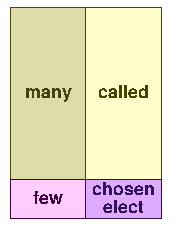
Matthew 22:14 For many are called, but few are chosen. [kjv]
πολλοι γαρ εισιν κλητοι ολιγοι δε εκλεκτοι [gnt]
Of the
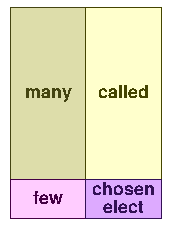
"many" called in the Parable of the Wedding Feast, only
one is
"chosen" to go into "
outer" "
darkness".
Paraphrase:
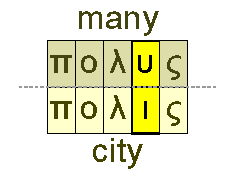
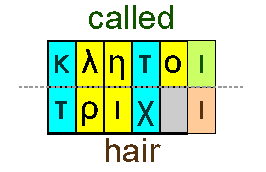
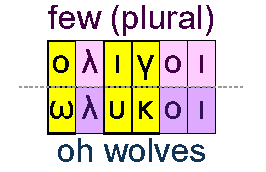
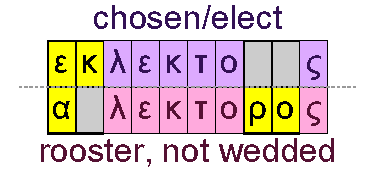
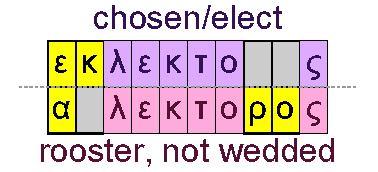
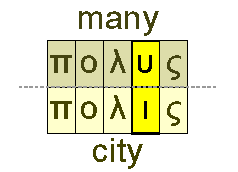
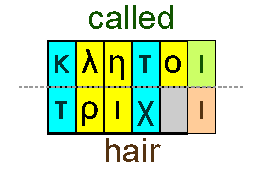
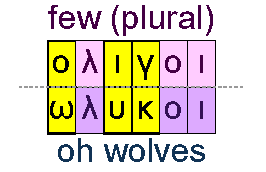
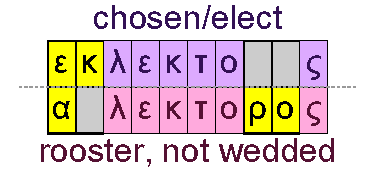
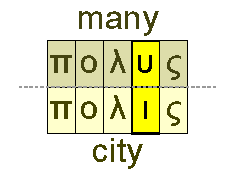
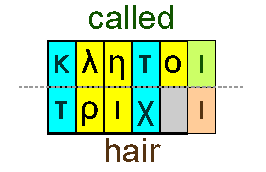
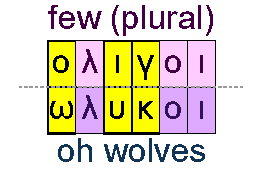
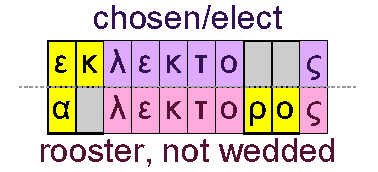
Many [city] are called [hairs] but few [O wolves] are chosen [roosters].
How
"many" is
"many"? How
"few" is
"few"?
3. Election callings as used by Jesus
Matthew 22:14 For many are called, but few are chosen. [kjv]
πολλοι γαρ εισιν κλητοι ολιγοι δε εκλεκτοι [gnt]
24:22 And except those days should be shortened, there should no flesh be saved: but for the elect's sake those days shall be shortened. [kjv]
24:24 For there shall arise false Christs, and false prophets, and shall shew great signs and wonders; insomuch that, if it were possible, they shall deceive the very elect. [kjv]
24:31 And he shall send his angels with a great sound of a trumpet, and they shall gather together his elect from the four winds, from one end of heaven to the other. [kjv]
Jesus uses the noun for
"elect" or
"chosen" three times in Matthew 24 and
one other time, at the end of the Parable of the Wedding feast in Matthew 22. These nouns are either mistranslated in context or ambiguous in use (or both).
4. Matthew 24:3 Olivet Discourse
Matthew 24:3 And as he sat upon the mount of Olives, the disciples came unto him privately, saying, Tell us, when shall these things be? and what shall be the sign of thy coming, and of the end of the world? [kjv]
καθημενου δε αυτου επι του ορους των ελαιων προσηλθον αυτω οι μαθηται κατ ιδιαν λεγοντες ειπε ειπον ημιν ποτε ταυτα εσται και τι το σημειον της σης παρουσιας και της συντελειας του αιωνος [gnt]
Paraphrase:
... Tell us, when will what you have just been saying be. That is, when will the religious establishment acknowledge what you have been saying about oppressing the believers at the bottom? When shall this cooperative effort take place into the ages?
Jesus then follows with an extended discourse. The apparent meaning of this extended discourse, called the Olivet Discourse, is that the cooperation that should happen will
never happen into the ages until the final end of time (as we know it) when heaven and earth will pass by. It will happen when pigs fly!
5. Combinatorics: Pigeonhole principle
Matthew 24:5 For many shall come in my name, saying, I am Christ; and shall deceive many. [kjv]
πολλοι γαρ ελευσονται επι τω ονοματι μου λεγοντες εγω ειμι ο χριστος και πολλους πλανησουσιν [gnt]
The field of
combinatorics has to do with arranging objects -
combination,
permutations, etc.
Pigeonhole principle: Pigeons are to be placed in pigeonholes. If there are more pigeons than there are pigeonholes, then at least one pigeonhole will have more than one pigeon.
Note that a "
dove" (from a Germanic word) and a "
pigeon" (from a Latin word) are two names for the same "
bird".
6. Matthew 24:6-8 Verses
Matthew 24:6 And ye shall hear of wars and rumours of wars: see that ye be not troubled: for all these things must come to pass, but the end is not yet. [kjv]
μελλησετε δε ακουειν πολεμους και ακοας πολεμων ορατε μη θροεισθε δει γαρ παντα γενεσθαι αλλ ουπω εστιν το τελος [gnt]
24:7 For nation shall rise against nation, and kingdom against kingdom: and there shall be famines, and pestilences, and earthquakes, in divers places. [kjv]
εγερθησεται γαρ εθνος επι εθνος και βασιλεια επι βασιλειαν και εσονται λιμοι και λοιμοι και σεισμοι κατα τοπους [gnt]
24:8 All these are the beginning of sorrows. [kjv]
παντα δε ταυτα αρχη ωδινων [gnt]
7. Matthew 24:9 Alternate paraphrase
Matthew 24:9 Then shall they deliver you up to be afflicted, and shall kill you: and ye shall be hated of all nations for my name's sake. [kjv]
τοτε παραδωσουσιν υμας εις θλιψιν και αποκτενουσιν υμας και εσεσθε μισουμενοι υπο παντων των εθνων δια το ονομα μου [gnt]
Alternate paraphrase (using Greek meanings and play on words):
Then shall they tradition (hand over) you into (peer and deceptive) pressure (affliction) and shall kill you (your soul, through deception) and you shall be hatefully rewarded under all those peoples through the (deceptive use of) my name.
Did Jesus warn about false teachers using his name and other deceptions in this discourse?
Why might this verse be related to those false teachers (and followers) and deceptions?
8. Matthew 24:21 Great peer pressure
Matthew 24:21 For then shall be great tribulation, such as was not since the beginning of the world to this time, no, nor ever shall be. [kjv]
εσται γαρ τοτε θλιψις μεγαλη οια ου γεγονεν απ αρχης κοσμου εως του νυν ουδ ου μη γενηται [gnt]
The ancient Greek word
"θλῖψις" ≈ "pressure" and,
figuratively,
"oppression",
"affliction", etc. [broken cross, true vs. false]
By the
pigeonhole principle, there is a lot of
self-deception. Might this include
peer pressure?
Paraphrase:
For then shall by great pressure (peer pressure) that has not been (come into being) since the beginning of the (people in the) world until now, neither has ever been (come into being).
9. Matthew 24:22 Christ's shortening
Matthew 24:22 And except those days should be shortened, there should no flesh be saved: but for the elect's sake those days shall be shortened. [kjv]
και ει μη εκολοβωθησαν αι ημεραι εκειναι ουκ αν εσωθη πασα σαρξ δια δε τους εκλεκτους κολοβωθησονται αι ημεραι εκειναι [gnt]
The analogy of "
Christ's"
"shortening" with "
Crisco"
"shortening" appears to be a
half-baked idea,
even (
oven) if the words sound similar. Let's put this idea on the
back burner.
To be
fully baked, perhaps something needs to be "
taken" and "
put" into a "
fire" pit of some kind. Perhaps "
outer" "
darkness" would be sufficient. Might the "
darkness" be achieved by "
darkening" the "
sun"? Such a "
darkness" might be similar to the "
blind" leading the "
blind".
10. Matthew 24:22 Greek word order
Matthew 24:22 And except those days should be shortened, there should no flesh be saved: but for the elect's sake those days shall be shortened. [kjv]
και ει μη εκολοβωθησαν αι ημεραι εκειναι ουκ αν εσωθη πασα σαρξ δια δε τους εκλεκτους κολοβωθησονται αι ημεραι εκειναι [gnt]
Greek word order:
and if not (potential) curtailed/shortened the days those [there yes] not (actual) if saved all flesh through/by then/however the elect curtailed/shortened the days those [there yes].
Whatever is meant by
"shortened" "
days", the
"elect" will be the cause of (some of) it.
Jesus appears to be making a
logical statement. Why use
opinion when Jesus makes a
logical statement?
11. Lies
There are a terrible lot of lies going about the world, and the worst of it is that half of them are true. Winston Churchill (British statesman)

How might one determine what is
true and what is
not true?
12. Logical reasoning and reasoning fallacies
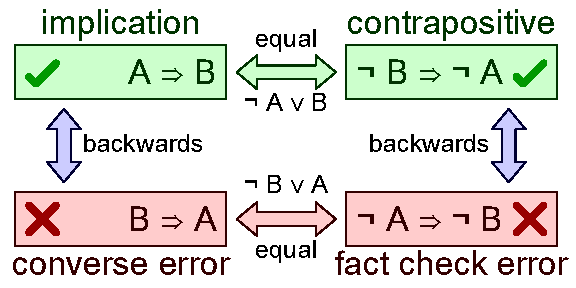
Let
A be the
reasoning. Let
B be the
conclusion.
There are a terrible lot of lies going about the world, and the worst of it is that half of them are true. Winston Churchill.
Can you see the
symmetry in the logical reasoning and reasoning fallacies?
If one is mistaken, then everything
true becomes
false and everything
false becomes
true .
13. Logical inference groups
| The following are all equivalent. |
| A implies B |
modens ponens |
| B if A |
(top down) |
| (not B) or A |
|
| (not B) implies (not A) |
modens tollens |
| A or (not B) |
|
|
 |
The two tables are
symmetric. If the top table is
true, then the bottom table is
not true, that is,
false, and vice-versa.
| The following are all equivalent. |
| B implies A |
converse error |
| A if B |
(top down) |
| (not A) or B |
|
| (not A) implies (not B) |
fact check fallacy |
| B or (not A) |
|
|
 |
There are a terrible lot of lies going about the world, and the worst of it is that half of them are true. Winston Churchill.
Note that if the bottom table is
true, then the top table is
not true or
false. To see this requires algebraic substitution of names for other names (as in a code). This is part of the programming process in computer science, software engineering, etc.
14. Modus ponens and modus tollens
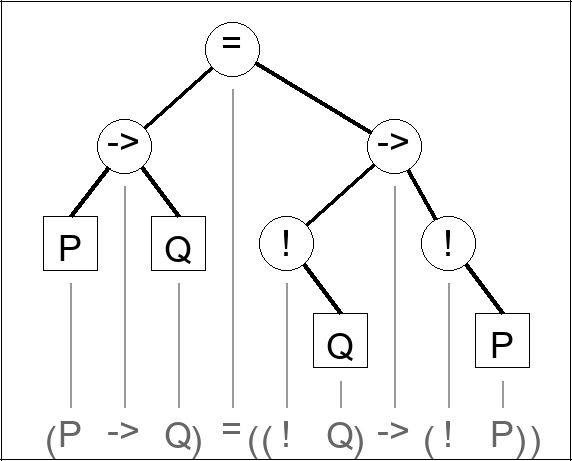 |
P Q | ( P -> Q ) = ( ( ! Q ) -> ( ! P ) )
-----------------------------------------
0 0 | ( 0 1 0 ) 1 ( ( 1 0 ) 1 ( 1 0 ) )
0 1 | ( 0 1 1 ) 1 ( ( 0 1 ) 1 ( 1 0 ) )
1 0 | ( 1 0 0 ) 1 ( ( 1 0 ) 0 ( 0 1 ) )
1 1 | ( 1 1 1 ) 1 ( ( 0 1 ) 1 ( 0 1 ) )
|
The expressions are the same since the values under the equal sign "
=" are all
1 or
true.
15. Implication is not the same as the fact check fallacy
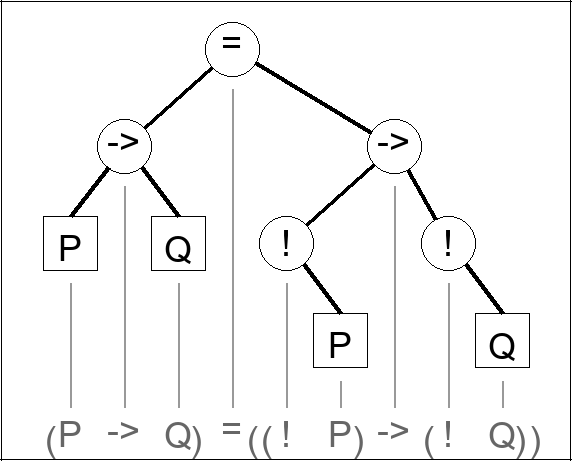 |
P Q | ( P -> Q ) = ( ( ! P ) -> ( ! Q ) )
-----------------------------------------
0 0 | ( 0 1 0 ) 1 ( ( 1 0 ) 1 ( 1 0 ) )
0 1 | ( 0 1 1 ) 0 ( ( 1 0 ) 0 ( 0 1 ) )
1 0 | ( 1 0 0 ) 0 ( ( 0 1 ) 1 ( 1 0 ) )
1 1 | ( 1 1 1 ) 1 ( ( 0 1 ) 1 ( 0 1 ) )
|
Here is an extended truth table proof that the
fact check fallacy is
not equivalent to
implication.
The expressions are
not the same since the values under the equal sign "
=" are
not all
1 or
true.
16. Fact check fallacy and converse error
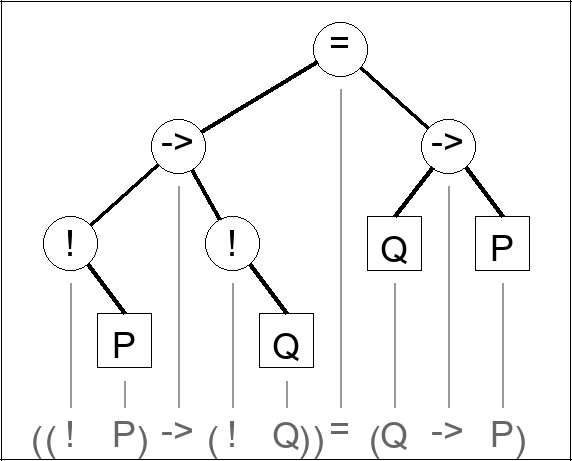 |
P Q | ( ( ! P ) -> ( ! Q ) ) = ( Q -> P )
-----------------------------------------
0 0 | ( ( 1 0 ) 1 ( 1 0 ) ) 1 ( 0 1 0 )
0 1 | ( ( 1 0 ) 0 ( 0 1 ) ) 1 ( 1 0 0 )
1 0 | ( ( 0 1 ) 1 ( 1 0 ) ) 1 ( 0 1 1 )
1 1 | ( ( 0 1 ) 1 ( 0 1 ) ) 1 ( 1 1 1 )
|
Here is an extended truth table proof that the
fact check fallacy is equivalent to the
converse error.
The expressions are the same since the values under the equal sign "
=" are all
1 or
true.
17. Matthew 24:22 Variable operands and operators
Matthew 24:22 And except those days should be shortened, there should no flesh be saved: but for the elect's sake those days shall be shortened. [kjv]
και ει μη εκολοβωθησαν αι ημεραι εκειναι ουκ αν εσωθη πασα σαρξ δια δε τους εκλεκτους κολοβωθησονται αι ημεραι εκειναι [gnt]
| Variable operands for the verse |
| X |
εκολοβωθησαν αι ημεραι εκειναι |
those days be shortened |
no "nt" |
| X |
κολοβωθησονται αι ημεραι εκειναι |
those days be shortened |
"nt" |
| Y |
εσωθη πασα σαρξ |
saved all flesh |
|
| E |
δια (τους) εκλεκτους |
by the elect |
|
| Connective operators for the verse |
| if not |
ει μη |
if not |
"I am" |
| if not |
ουκ αν |
if not |
|
| but by |
δια δε |
through but |
|
To support the idea of a
good "elect". the Greek for
"by" or
"through" was changed (reversed) to
"for".
18. Matthew 24:22 Abstracted logic
Matthew 24:22 And except those days should be shortened, there should no flesh be saved: but for the elect's sake those days shall be shortened. [kjv]
Let
X be "
those days/parts be shortened or cut off",
Y be "
flesh saved",
E be
"elect".
1. if not X then not Y but by E is X. (as stated, modus tollens)
2. if Y then X but by E is X. (modus ponens)
E is self-deceived (surrounding verses) and decides that Y needs to be achieved (equivocation on "flesh" and "saved") by doing X (converse fallacy).
3. if X then Y but (since) by E is X. (converse fallacy by E)
E (deceived) decides that X needs to be done to get Y and convinces others "in this way/manner" (surrounding verses).
4. if not Y then not X but (since) by E is X. (restated as fact check fallacy)
In three verses, Jesus will remind us that he had told us this before.
19. Matthew 24:22 Paraphrase
Matthew 24:22 And except those days should be shortened, there should no flesh be saved: but for the elect's sake those days shall be shortened. [kjv]
και ει μη εκολοβωθησαν αι ημεραι εκειναι ουκ αν εσωθη πασα σαρξ δια δε τους εκλεκτους κολοβωθησονται αι ημεραι εκειναι [gnt]
Paraphrase using the above logic:
And if those days [parts there yes] were not cut off (horns/rules removed) no flesh would be saved, but though the (deceived) elect's (false) ideas, those days [parts there yes] will be cut off (horns/rules removed) in order to (invalid logic) save all flesh.
Jesus wants to "cut off" certain unnecessary horns/rules/parts (yoke of compulsion) in order to "save" "all" "flesh" in a "heavenly" manner.
The (deceived) "elect" want to "cut off" all horns/rules/parts in the (false) idea that this will "save" "all" "flesh" in a "worldly" manner.
Discuss: Has it ever happened that
false teachers want to "
cut off"
all horns/rules/parts in order that
all "
flesh" might be "
saved"? Does it help fill the pews (or their own salary)?
20. Matthew 24:23 Way of here and there manners
Matthew 24:23 Then if any man shall say unto you, Lo, here is Christ, or there; believe it not. [kjv]
τοτε εαν τις υμιν ειπη ιδου ωδε ο χριστος η ωδε μη πιστευσητε [gnt]
The ancient Greek word
"ὧδε" ≈ "in this way, thus" and comes from
"ὅδε" ≈ "this". Translating the word as
"here" loses the idea of the
manner or
way in which something is done.
KJV (King James Version): ... here is Christ or there is Christ - do not believe it. (localized false Christ)
Greek word meaning: ... in this way/manner is Christ or in this way/manner is Christ - do not believe it. (general idea of a false Christ)
Discuss: Can one be a
false Christ if one repeats, in the
same manner/way, ideas that a
false Christ would say?
There is a
disjunction using
"or" in this verse.
21. Matthew 24:24 Elective deceptions
Matthew 24:24 For there shall arise false Christs, and false prophets, and shall shew great signs and wonders; insomuch that, if it were possible, they shall deceive the very elect. [kjv]
εγερθησονται γαρ ψευδοχριστοι και ψευδοπροφηται και δωσουσιν σημεια μεγαλα και τερατα ωστε πλανησαι πλανασθαι ει δυνατον και τους εκλεκτους [gnt]
To what does this refer?
The deception of the elect. Who are the
"elect"?
☐ Suppose the
"elect" are
good. Can the false Christs and false teachers
"deceive" the
"elect"?
☐ Suppose the
"elect" are
not good. Can the false Christs and false teachers
"deceive" the
"elect"?
☐ Suppose the
"elect" are the false Christs and false teachers. Can the
"elect" "deceive" themselves? That is, self-deception.
Is it
"potentially possible" to
"deceive" someone who is already
"deceived" or has
self "deceived"?
22. Matthew 24:24 Possible
Matthew 24:24 For there shall arise false Christs, and false prophets, and shall shew great signs and wonders; insomuch that, if it were possible, they shall deceive the very elect. [kjv]
Here is an analogy of a statement made by a lawyer defending his politician client accused of corruption.
Lawyer: There is not one shred of evidence that my client is corrupt.
Lawyer: And it is not possible that my client will become corrupt.
Here is an analogy for the
"elect"
There is not one shred of evidence that the elect are deceived.
And it is not possible that the elect will become deceived.
23. Matthew 24:25-31 Told before
Matthew 24:25 Behold, I have told you before. [kjv]
ιδου προειρηκα υμιν [gnt]
The Greek word translated as "
behold" is that of "
look around and (logically) analyze what you see".
If Jesus tells them
"before" then has what he is now describing happened before?
24. Matthew 24:31 Angels choose the elect
Matthew 24:31 And he shall send his angels with a great sound of a trumpet, and they shall gather together his elect from the four winds, from one end of heaven to the other. [kjv]
και αποστελει τους αγγελους αυτου μετα σαλπιγγος φωνης μεγαλης και επισυναξουσιν τους εκλεκτους αυτου εκ των τεσσαρων ανεμων απ ακρων ουρανων εως των ακρων αυτων [gnt]
Who are the
"elect"? Are they
rooster birds? Neither this verse nor the verse that follows (the fig tree) indicate what happens to the
"elect".
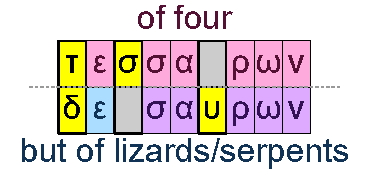
The Greek word translated as "four" can be a play on words with (four) "lizard".
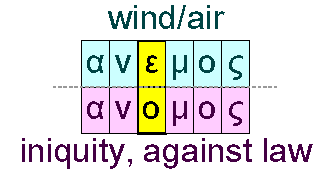
The Greek word translated as "winds" can be a play on words with "against the law" or "iniquity".
25. Matthew 24:31
Matthew 24:31 And he shall send his angels with a great sound of a trumpet, and they shall gather together his elect from the four winds, from one end of heaven to the other. [kjv]
και αποστελει τους αγγελους αυτου μετα σαλπιγγος φωνης μεγαλης και επισυναξουσιν τους εκλεκτους αυτου εκ των τεσσαρων ανεμων απ ακρων ουρανων εως των ακρων αυτων [gnt]
The "angels" are the "reapers". There are many "trumpets" in Revelation.
The Greek word translated as "his" is that of "his/it" (masculine/neuter).
The "ends" are one point to another point, such as from the "beginning" of time, or "east", to the "end" of time, or "west".
26. Matthew 13:47-50 KP7 parable verses
The seventh kingdom parable is the harvest at the end of the age.
Matthew 13:47 Again, the kingdom of heaven is like unto a net, that was cast into the sea, and gathered of every kind: [kjv]
13:48 Which, when it was full, they drew to shore, and sat down, and gathered the good into vessels, but cast the bad away. [kjv]
Verses 49 and 50 appear to be a
restatement of verses 47 and 48.
13:49 So shall it be at the end of the world: the angels shall come forth, and sever the wicked from among the just, [kjv]
13:50 And shall cast them into the furnace of fire: there shall be wailing and gnashing of teeth. [kjv]
One assumes that there are "
fish" in the "
net" but this is
never stated. In real life, "
birds", "
animals" and other creatures might be caught in a "
net".
27. Chosen elect
Matthew 13:49 So shall it be at the end of the world: the angels shall come forth, and sever the wicked from among the just, [kjv]
ουτως εσται εν τη συντελεια του αιωνος εξελευσονται οι αγγελοι και αφοριουσιν τους πονηρους εκ μεσου των δικαιων [gnt]
13:50 And shall cast them into the furnace of fire: there shall be wailing and gnashing of teeth. [kjv]
και βαλουσιν αυτους εις την καμινον του πυρος εκει εσται ο κλαυθμος και ο βρυγμος των οδοντων [gnt]
24:31 And he shall send his angels with a great sound of a trumpet, and they shall gather together his elect from the four winds, from one end of heaven to the other. [kjv]
Are these verses a statement of basically the same idea? A good teacher often teaches the same thing in many different ways.
Who are the "chosen" or "elect" in these verses? What happens to them?
Is being one of the "elect" good or not good?
28. Matthew 24:40-41 Taken or left
Matthew 24:40 Then shall two be in the field; the one shall be taken, and the other left. [kjv]
τοτε δυο εσονται δυο εν τω αγρω ο εις παραλαμβανεται και ο εις αφιεται [gnt]
24:41 Two women shall be grinding at the mill; the one shall be taken, and the other left. [kjv]
δυο αληθουσαι εν τω μυλωνι μυλω μια παραλαμβανεται και μια αφιεται [gnt]
The Greek for
"left" is often translated as
"forgiven". Where is the other
"taken"?
Is it better to be "taken over" or "left"?
Is it better to be "taken over" and "thrown out" (a few verses later) or "left" and/or "forgiven"?
The ancient Greek word
"παραλαμβάνω" ≈ "take over (by consent or force)". Literally, it is "
beyond"
"taking". How is this word to be taken in these verses? The only thing Jesus says you are to do is to
"take" is your "
cross" and "
follow" Him. However, Jesus is not bound by this
"take" restriction.
29. Matthew 24:51 End of the chapter
Matthew 24:51 And shall cut him asunder, and appoint him his portion with the hypocrites: there shall be weeping and gnashing of teeth. [kjv]
This ends the chapter of the Olivet Discourse on the End Times.
To where have the "hypocrites" or "pretenders" or "actors" gone? Who are the "many"?
Who are the "few"? What happened to them? Are these the "elect"?
Who are the "many" who are "left" or "forgiven"?
30. William Miller: Millerism
Matthew 24:41 Two women shall be grinding at the mill; the one shall be taken, and the other left. [kjv]
δυο αληθουσαι εν τω μυλωνι μυλω μια παραλαμβανεται και μια αφιεται [gnt]
Millerites were followers of
William Miller (1782-1849) in a movement called
Millerism. Miller was a Baptist lay preacher in northeast New York state. From his study of selected parts of English translations of the Bible, Miller predicted the Second Coming of Christ in the 1840's. Some followers of this movement became
Adventists such as the Seventh Day Adventists.
31. John Nelson Darby: Rapture
John Nelson Darby (1800-1882) as Anglo-American Bible teacher who developed a theory of the
rapture from cherry-picked English translations of the Bible. His ideas
enraptured many.
Latin: "rapture".
Greek: "snatching up" (harpooning).
Called the father of modern sensationalism. Darby had ideas that led to ideas of
inerrancy and
infallibly of the
scriptures. [DeMorgan, Boole, and modern logic]
[Darby Bibles - German (1871), French (1859), English (1870) - translated from the Hebrew and Greek (as understood from the Latin)]
32. Cyrus Scofield: Reference Bible
Cyrus Scofield (1843-1921) and his
Scofield Reference Bible (1909, 1917, etc.) with concordance, index, cross references, etc. (dispensations)
Prior to World War I, there was a cultural optimism as if the millennium of the Bible had already arrived.
Many ideas were cultivated as fulfilling prophecy. Part of this was a homeland for the return of Israel.
33. Hal Lindsey: Late Great Planet Earth
Hal Lindsey (1929-2024) was an American evangelical writer and television host. His 1970 book
The Late Great Planet Earth, based in ideas of the
rapture, sold (to date) almost 30 millions copies.
His TV series was called
The Hal Lindsey Report.
There were many follow-on books. The basic idea was that current events showed that the end time rapture was about to happen.
As with any such predictions, a house of cards in constructed by cherry-picking Bible verses, many using the English meaning of the translation. If any card turns out to not be what it was assumed to be. the entire house starts to fall. That fall could be great.
34. Tim LaHay: Left behind
The "
Left behind" series of books (1995-2007) by Tim LaHay (1926-2016) and Jerry B. Jenkins deals with the tribulation period in the Bible in general and the rapture in particular.
BIBLE (Basic Instructions Before Leaving Earth),
Much of the stories are based on the Bible but make certain assumptions that may or may not be true.
In particular, the idea that bodies will just disappear is assumed. It may happen that just the soul disappears and those that are left, after some major global catastrophe, do not realize that the rapture has happened.
35. Rapture and toilet paper
One idea many people have about the rapture, much of it from the Left Behind series of books, is that all believers will disappear.
This is similar to the shelves of toilet paper disappearing as a result of panic buying. This leads to the phrase, "
When the roll is called up yonder" from the hymn of the same name.
36. Brief history highlights
Jesus and cursed fig tree. Danger of moving mountains/definitions.
Jesus and the house, temple, end times.
Latin mistranslations to divert attention. Means, motive, opportunity.
English translation of Latin. Consequent English word meaning changes.
English cherry-picking of verses, inerrancy, whisper chain, etc., by Darby, Miller, Schofield, Hal Lindsey, La Haye, etc.
Adoption by conservative movements (some true, much not true)
Opposite reaction and adoption by liberal movements (some true, much not true).
37. Matthew 22:14 Many called few chosen
Matthew 22:14 For many are called, but few are chosen. [kjv]
πολλοι γαρ εισιν κλητοι ολιγοι δε εκλεκτοι [gnt]
Of the
"many" called in the Parable of the Wedding Feast, only
one is
"chosen" to go into "
outer" "
darkness".
Paraphrase:
Many [city] are called [hairs] but few [O wolves] are chosen [roosters].
How
"many" is
"many"? How
"few" is
"few"?
38. Election callings as used by others and not Jesus
Matthew 22:14 For many are called, but few are chosen. [kjv]
πολλοι γαρ εισιν κλητοι ολιγοι δε εκλεκτοι [gnt]
Jesus appears to use the Greek word for
"elect" in a
not good way. The corresponding "
verb" form is not a code word, but, in general, may be a play on words.
Early church fathers: Clement, Ignatius, Barnabas, etc.
Paul, Peter, etc.
How did each of these use the word for
"elect"?
39. End of page