Send
Close Add comments:
(status displays here)
Got it! This site "www.creationpie.org" uses cookies. You consent to this by clicking on "Got it!" or by continuing to use this website. Note: This appears on each machine/browser from which this site is accessed.
Philippians 4:9-11 Being content with self-sufficiency
1. Background
Paul has just provided a laundry list of topics that appear to be a code indicating the help of a second author.
2. List of words
| Special words |
| 1=ε‑στιν |
is |
(1 lambda) |
| 2=α‑λη‑θη |
true |
εληνα= |
| 3=σεμ‑να |
important |
=Greek |
| 4=δι‑και‑α |
righteous |
καινα= |
| 5=αγ‑να |
pure |
=new |
| 6=προ ‑σφι‑λη |
lovely |
|
| 7=ευ‑φη ‑μα |
good report |
προφητη = |
| 8=α‑ρε‑τη |
virtue |
=prophet |
| 9=ε‑παι‑νος |
praise |
παιζε= |
| 10=λο‑γι‑ζε‑σθε |
reasoned |
=plays |
|
Pastors may try to fit the words into a Christian lifestyle.
We are asked to "logically" "calculate" or "reason" about the words, not "think".
Start by dividing the Greek words into syllables. There may be other ways.
|
Note: The "
Greek" may be a female name and relate to the use of female names as codes in the previous verses. Another connection might be a feminine form of the ancient Greek word
"Λῆμνος" ≈ "Lumnos" as an island and coming from a Semitic word for "
white".
3. Things
Philippians 4:9 Those things, which ye have both learned, and received, and heard, and seen in me, do: and the God of peace shall be with you. [kjv]
α και εμαθετε και παρελαβετε και ηκουσατε και ειδετε εν εμοι ταυτα πρασσετε και ο θεος της ειρηνης εσται μεθ υμων [gnt]
4:10 But I rejoiced in the Lord greatly, that now at the last your care of me hath flourished again; where in ye were also careful, but ye lacked opportunity. [kjv]
εχαρην δε εν κυριω μεγαλως οτι ηδη ποτε ανεθαλετε το υπερ εμου φρονειν εφ ω και εφρονειτε ηκαιρεισθε δε [gnt]
4. Philippians 4:9
KJV: Those things, which ye have both learned, and received, and heard, and seen in me, do: and the God of peace shall be with you.
Greek: α και εμαθετε και παρελαβετε και ηκουσατε και ειδετε εν εμοι ταυτα πρασσετε και ο θεος της ειρηνης εσται μεθ υμων
5. Philippians 4:10
KJV: But I rejoiced in the Lord greatly, that now at the last your care of me hath flourished again; where in ye were also careful, but ye lacked opportunity.
Greek: εχαρην δε εν κυριω μεγαλως οτι ηδη ποτε ανεθαλετε το υπερ εμου φρονειν εφ ω και εφρονειτε ηκαιρεισθε δε
6. Philippians 4:9-11 Being content with self-sufficiency
Philippians 4:11 Not that I speak in respect of want: for I have learned, in whatsoever state I am, therewith to be content. [kjv]
ουχ οτι καθ υστερησιν λεγω εγω γαρ εμαθον εν οις ειμι αυταρκης ειναι [gnt]
In Philippians 4:11, the
KJV (King James Version) says that Paul says that he has learned to be "
content" in whatsoever state he finds himself.
Might there be a reason why, at some point, the church preferred followers to be "
content" in a passive way, as in "
having enough", rather than be "
self-sufficient" in an active way?
7. Background
Philippians 4:11 Not that I speak in respect of want: for I have learned, in whatsoever state I am, therewith to be content. [kjv]
ουχ οτι καθ υστερησιν λεγω εγω γαρ εμαθον εν οις ειμι αυταρκης ειναι [gnt]
The Greek word translated "
content" is made up of two parts that, literally, mean that of being "
self-sufficient". This comes though Latin into the Middle Ages.
Some background is needed on the Greek for "
sufficient" which is related to the Latin word for "
ark" as in a box.
8. The enclosing of an ark
9. Context
Let us look at the verse itself and then at the larger context.
Philippians 4:11 Not that I speak in respect of want: for I have learned, in whatsoever state I am, therewith to be content. [kjv]
ουχ οτι καθ υστερησιν λεγω εγω γαρ εμαθον εν οις ειμι αυταρκης ειναι [gnt]
The
KJV infers and translates a Greek pronoun meaning "
that which" as "
state" as in a "
condition".
10. Strongs - that which
*G3739 *1396 ὅς (hos) : he hay, and neuter ho ho probably a primary word (or perhaps a form of the article 3588); the relatively (sometimes demonstrative) pronoun, who, which, what, that:--one, (an-, the) other, some, that, what, which, who(-m, -se), etc.
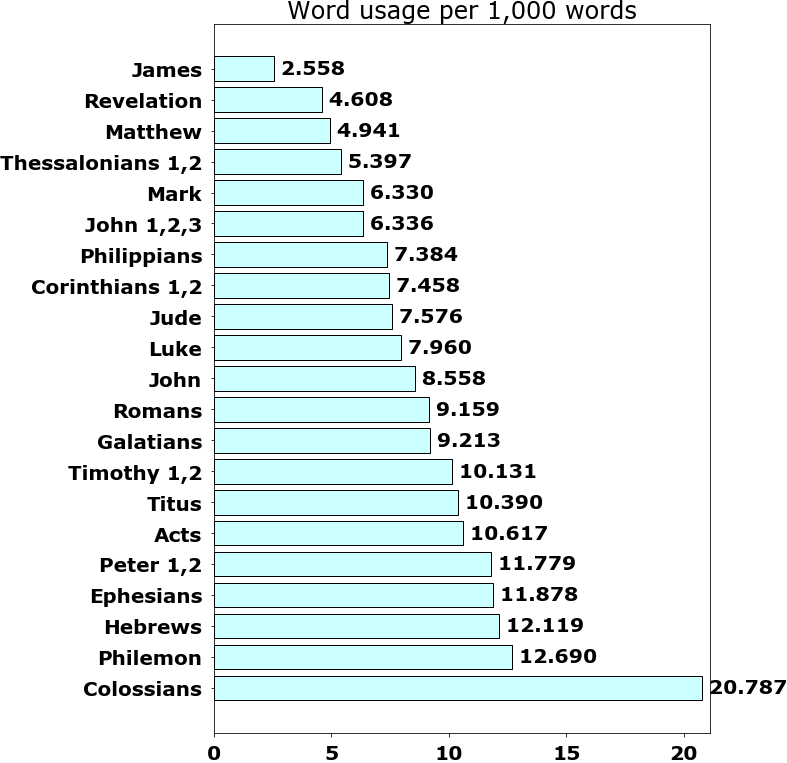 |
Words: α=115 αι=5 αις=15 ας η=42 ην=97 ης=49 ο=246 οι=34 οις=46 ον=166 ος=217 ου=114 ους=51 ω=121 ων=79
|
11. Contented state
Philippians 4:11 Not that I speak in respect of want: for I have learned, in whatsoever state I am, therewith to be content. [kjv]
ουχ οτι καθ υστερησιν λεγω εγω γαρ εμαθον εν οις ειμι αυταρκης ειναι [gnt]
A joke from the English of this verse is that Paul must not have been a Texan as he was "
content" to be in any "
state".
12. State of matter
|
|
|
| 1 |
Delaware |
| 2 |
Pennsylvania |
| 3 |
New Jersey |
| 4 |
Georgia |
| 5 |
Connecticut |
| 6 |
Massachusetts |
| 7 |
Maryland |
|
Note that the three states of matter are
solid,
liquid and
gas. The fourth state is
plasma (disassociated ions). The fifth "
state" of matter might be in Connecticut (the 5th state into the union).
Note: In the beginning of Genesis, if the word "
waters" is replaced with "
plasma", the creation story makes a lot more sense.
13. Plasma and waters
Genesis 1:6 And God said, Let there be a firmament in the midst of the waters, and let it divide the waters from the waters. [kjv]
1:7 And God made the firmament, and divided the waters which were under the firmament from the waters which were above the firmament: and it was so. [kjv]
1:8 And God called the firmament Heaven. And the evening and the morning were the second day. [kjv]
… יום … [he]
The "
waters" in the creation story in Genesis 1 fit well with the physical properties of a "
plasma", as the entropy (disorder) of the system of the created universe is decreased each day.
14. Philippians 4:11 Paul
15. Autarky
The English word
"autarky" is from the ancient Greek word
"αὐτάρκεια" ≈ "self-sufficient" and means an
economic independence or self-sufficiency.
In the world of today it is not really possible to be totally self-sufficient. In
OT (Old Testament) times, there were groups that raised their own crops, etc. Even Jacob, during the famine, needed to send his sons to Egypt for food. And Joseph was there because he was sold to a traveling merchant caravan.
The English word
"autarchy" is a self-rule of
government.
16. Automatic
17. Automatic fruit
Mark 4:28 For the earth bringeth forth fruit of herself; first the blade, then the ear, after that the full corn in the ear. [kjv]
αυτοματη γαρ η γη καρποφορει πρωτον χορτον ειτα ειτεν σταχυν ειτα ειτεν πληρη σιτον εν τω σταχυι [gnt]
The earth bringeth forth fruit of herself - automatically. The ancient Greek word
"αὐτόματος" ≈ "self-willed, self-moving" and is the source of the English word
"automatic" and comes from two Greek words.
The ancient Greek word "αὐτο" ≈ "self" (and is a pronoun for masculine "it" or "he").
The ancient Greek word "μένος" ≈ "mind" as in thinking.
The
GNT uses the word for "
automatic" to refer to fruit growing automatically on trees and for automatic doors.
18. Mark 4:28
KJV: For the earth bringeth forth fruit of herself; first the blade, then the ear, after that the full corn in the ear.
Greek: αυτοματη γαρ η γη καρποφορει πρωτον χορτον ειτα ειτεν σταχυν ειτα ειτεν πληρη σιτον εν τω σταχυι
19. Automatic doors to a street
Acts 12:10 When they were past the first and the second ward, they came unto the iron gate that leadeth unto the city; which opened to them of his own accord: and they went out, and passed on through one street; and forthwith the angel departed from him. [kjv]
διελθοντες δε πρωτην φυλακην και δευτεραν ηλθον ηλθαν επι την πυλην την σιδηραν την φερουσαν εις την πολιν ητις αυτοματη ηνοιχθη ηνοιγη αυτοις και εξελθοντες προηλθον ρυμην μιαν και ευθεως απεστη ο αγγελος απ αυτου [gnt]
The ancient Greek word
"αὐτόματος" ≈ "self-willed, self-moving" and is the source of the English word
"automatic". The doors opened
"automatically" and led to a
"street" of
"hustle and bustle" which comes from
"ῥύμη" ≈ "force of a body in motion, charge of soldiers".
The
KJV translation of this verse is the source of some jokes that it involved a Honda
Accord (a model of car).
20. Acts 12:10
KJV: When they were past the first and the second ward, they came unto the iron gate that leadeth unto the city; which opened to them of his own accord: and they went out, and passed on through one street; and forthwith the angel departed from him.
Greek: διελθοντες δε πρωτην φυλακην και δευτεραν ηλθον ηλθαν επι την πυλην την σιδηραν την φερουσαν εις την πολιν ητις αυτοματη ηνοιχθη ηνοιγη αυτοις και εξελθοντες προηλθον ρυμην μιαν και ευθεως απεστη ο αγγελος απ αυτου
21. Modern Greek
22. Philippians 4:11
KJV: Not that I speak in respect of want: for I have learned, in whatsoever state I am, therewith to be content.
Greek: ουχ οτι καθ υστερησιν λεγω εγω γαρ εμαθον εν οις ειμι αυταρκης ειναι
Latin: non quasi propter penuriam dico ego enim didici in quibus sum sufficiens esse
Wycliffe: for Y haue lerud to be sufficient in whiche thingis Y am.
Gothic: ni thatei bi tharbai qithau, unte ik galaisida mik in thaimei im ganohiths wisan.
Luther: Nicht sage ich das des Mangels halben; denn ich habe gelernet, bei welchen ich bin, mir genügen lassen.
Spanish: No lo digo porque tenga escasez; pues he aprendido a contentarme, cualquiera que sea mi situación.
Portuguese: Não falo assim por me sentir carecido. Pois, no meu caso, aprendi a ser autónomo nas situações em que me encontre.
23. Latin
24. Wycliffe
προς Φιλιππησίους δ΄:11 ουχ οτι καθ υστερησιν λεγω εγω γαρ εμαθον εν οις ειμι αυταρκης ειναι [gnt]
… sufficiens … [v]
for Y haue lerud to be sufficient in whiche thingis Y am. [wy]
The Wycliffe translation uses "
sufficient", which might be from influence of the Latin Vulgate. Note also that the Middle English in the Wycliffe version uses "
Y am" for "
I am", while "
Y" was used for what became "
I".
25. German
26. English content
27. Content
The English word "
content" (accent on second syllable) has the implication of being "
sufficient" in "
oneself".
Accent on first syllable: of what something consists that is enclosed by some bounds
Accent on second syllable: feeling satisfied without a change needed
28. Word slide

The more
active idea of being "
self-sufficient" changed to the more
passive idea of being "
content". The
Greek "self-sufficient" went to
Latin "sufficient" went to
English "sufficient" went to
English "content".
A word slide appears to have happened.
29. Stoic self-sufficiency
The Stoic philosophical idea of "
self-sufficiency" had to do with focusing time and energy on things on which one could have some control and impact. The four main "
virtues" of Stoicism that arise from "
self-sufficiency" are the following.
wisdom
justice
courage
moderation
30. Seven habits
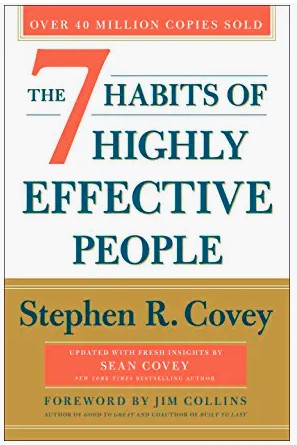
In Stephen Covey's book
7 habits of highly effective people (1989) the idea of self-sufficiency is expressed as "
shrinking one's domain of concern to one's domain of influence". That is, proactive people focus on what they can do and influence.
In management terms, this is balancing responsibility with authority.
Jesus brings out the same idea with shaking the dust off of one's sandals and leaving if an area is not receptive to the message. Paul brings out this message in Philippians in various ways.
31. Gothic
32. Stoic self-sufficiency
This Greek word for "
self-sufficiency" had a philosophical meaning to the
Stoics. This would have been more understood in Athens and Ephesus but less understood in other areas. Phillipi had some unique features.
The people were granted the coveted "Roman citizenship" after the battle of Phillipi where the conspirators who murdered Caesar and their followers were defeated.
The gold mines in the area, though declining, left certain people with wealth. This is seen in the street vendors hawking wares and what happens when Paul brings out the fortune-telling "spirit" of one slave girl working for those vendors.
33. Strongs - content
- *G842 *1 αὐτάρκης (ow-tar'-kace) : from G846 and G714; self-complacent, i.e. contented:--content.
- αυταρκης
- Philippians 4:11 ... whatsoever state I am, therewith to be content.
34. 2 Corinthians Self-sufficiency from God
2 Corinthians 9:8 And God is able to make all grace abound toward you; that ye, always having all sufficiency in all things, may abound to every good work: [kjv]
δυνατος δυνατει δε ο θεος πασαν χαριν περισσευσαι εις υμας ινα εν παντι παντοτε πασαν αυταρκειαν εχοντες περισσευητε εις παν εργον αγαθον [gnt]
How does changing
"sufficiency" to
"self-sufficiency" change the meaning of the verse?
This
"self-sufficiency" is that of coming from God rather than from one's own efforts. A word for this in the
GNT from the Hebrew is
"mammon"
35. 2 Corinthians 9:8
KJV: And God is able to make all grace abound toward you; that ye, always having all sufficiency in all things, may abound to every good work:
Greek: δυνατος δυνατει δε ο θεος πασαν χαριν περισσευσαι εις υμας ινα εν παντι παντοτε πασαν αυταρκειαν εχοντες περισσευητε εις παν εργον αγαθον
Latin: potens est autem Deus omnem gratiam abundare facere in vobis ut in omnibus semper omnem sufficientiam habentes abundetis in omne opus bonum
Wycliffe: And God is miyti to make al grace abounde in you, that ye in alle thingis euere more han al sufficience, and abounde in to al good werk;
Gothic: aththan mahteigs ist guth alla anst ufarassjan in izwis, ei in allamma sinteino allis ganauhan habandans ufarassjaith in allamma waurstwe godaize,
Luther: Gott aber kann machen, daß allerlei Gnade unter euch reichlich sei, daß ihr in allen Dingen volle Genüge habet und reich seid zu allerlei guten Werken,
Spanish: Y poderoso es Dios para hacer que abunde en vosotros toda gracia; a fin de que, teniendo siempre toda suficiencia en todas las cosas, abundéis para toda buena obra;
36. Timothy
1 Timothy 6:6 But godliness with contentment is great gain. [kjv]
εστιν δε πορισμος μεγας η ευσεβεια μετα αυταρκειας [gnt]
… sufficientia [v]
How does changing
"sufficiency" to
"self-sufficiency" change the meaning of the verse?
- "godliness with contentment"
- "godliness with self-sufficiency"
Here Paul is speaking to people in Ephesus which would be more aware of the philosophical meaning and background of the Greek word for
"self-sufficiency".
37. 1 Timothy 6:6
KJV: But godliness with contentment is great gain.
Greek: εστιν δε πορισμος μεγας η ευσεβεια μετα αυταρκειας
Latin: est autem quaestus magnus pietas cum sufficientia
Gothic: aththan ist gawaurki mikil gagudei mith ganauhin.
Luther: Es ist aber ein großer Gewinn, wer gottselig ist und lässet sich genügen.
Spanish: Pero gran ganancia es la piedad con contentamiento.
Portuguese: A piedade é, realmente, uma grande fonte de lucro para quem se contenta com o que tem.
38. Deuteronomy
Deuteronomy 32:10 He found him in a desert land, and in the waste howling wilderness; he led him about, he instructed him, he kept him as the apple of his eye. [kjv]
He maintained him in the wilderness, in burning thirst and a dry land: he led him about and instructed him, and kept him as the apple of an eye. [bs3]
Where they "
maintained"? Were they "
found"?
Were they "
self-sufficient"?
39. Deuteronomy 32:10
KJV: He found him in a desert land, and in the waste howling wilderness; he led him about, he instructed him, he kept him as the apple of his eye.
Hebrew: ימצאהו בארץ מדבר ובתהו ילל ישמן יסבבנהו יבוננהו יצרנהו כאישון עינו׃
Greek: αυταρκησεν αυτον εν γη ερημω εν διψει καυματος εν ανυδρω εκυκλωσεν αυτον και επαιδευσεν αυτον και διεφυλαξεν αυτον ως κοραν οφθαλμου
Brenton: He maintained him in the wilderness, in burning thirst and a dry land: he led him about and instructed him, and kept him as the apple of an eye.
40. Proverbs
Proverbs 30:8 Remove far from me vanity and lies: give me neither poverty nor riches; feed me with food convenient for me: [kjv]
Remove far from me vanity and falsehood: and give me not wealth or poverty; but appoint me what is needful and sufficient: [bs3]
Does "
self-sufficient" fit here? God provides what is "
needed" but one must then do something to take advantage of what is provided. This is similar to "
manna" in the wilderness.
 |
Details are left as a future topic.
|
41. Proverbs 30:8
KJV: Remove far from me vanity and lies: give me neither poverty nor riches; feed me with food convenient for me:
Hebrew: שוא ודבר כזב הרחק ממני ראש ועשר אל תתן לי הטריפני לחם חקי׃
Greek: ματαιον λογον και ψευδη μακραν μου ποιησον πλουτον δε και πενιαν μη μοι δως συνταξον δε μοι τα δεοντα και τα αυταρκη
Brenton: Remove far from me vanity and falsehood: and give me not wealth or poverty; but appoint me what is needful and sufficient:
Latin: vanitatem et verba mendacia longe fac a me mendicitatem et divitias ne dederis mihi tribue tantum victui meo necessaria
42. Strongs - destitution
- *G5304 *2 ὑστέρησις (hoos-ter'-ay-sis) : a falling short, i.e. (specially), penury:--want.
- υστερησεως
- Mark 12:44 ... she of her want did cast in all that ...
- υστερησιν
- Philippians 4:11 Not that I speak in respect of want: for I have learned, ...
43. Context
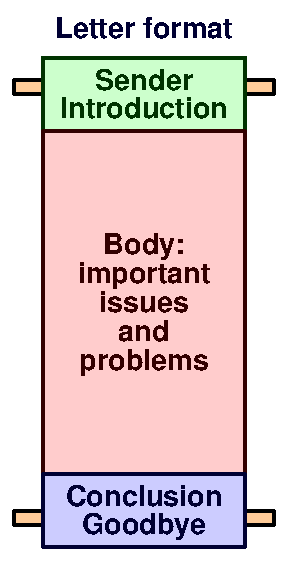
Let us return to the context of Philippians 4. This is the last chapter.
In general, the first and last part of a letter are somewhat boilerplate and pleasantries. It is not good to make too much of a theological statement from such verses while skipping the middle parts of the letter which was the reason the letter was written.
44. Paul
Philippians 4:10 But I rejoiced in the Lord greatly, that now at the last your care of me hath flourished again; where in ye were also careful, but ye lacked opportunity. [kjv]
εχαρην δε εν κυριω μεγαλως οτι ηδη ποτε ανεθαλετε το υπερ εμου φρονειν εφ ω και εφρονειτε ηκαιρεισθε δε [gnt]
That is, they have neglected, or been late in meeting, what he needed. The "
lacked opportunity" means "
did not have the time" and provides a nice out for the Philippians.
The "
care" and "
careful" are the Greek words that can be though of as being prudent, sensible or opportunistic.
45. Philippians 4:10
KJV: But I rejoiced in the Lord greatly, that now at the last your care of me hath flourished again; where in ye were also careful, but ye lacked opportunity.
Greek: εχαρην δε εν κυριω μεγαλως οτι ηδη ποτε ανεθαλετε το υπερ εμου φρονειν εφ ω και εφρονειτε ηκαιρεισθε δε
46. Content
We now have the main verse of the current discussion.
Philippians 4:11 Not that I speak in respect of want: for I have learned, in whatsoever state I am, therewith to be content. [kjv]
ουχ οτι καθ υστερησιν λεγω εγω γαρ εμαθον εν οις ειμι αυταρκης ειναι [gnt]
This might be stated as follows.
Possible translation:
Not that I speak in regards to being late in my needs being met (on your part) for I have learned in that respect to be self-sufficient.
47. Philippians 4:11
KJV: Not that I speak in respect of want: for I have learned, in whatsoever state I am, therewith to be content.
Greek: ουχ οτι καθ υστερησιν λεγω εγω γαρ εμαθον εν οις ειμι αυταρκης ειναι
48. Summary
In Philippians 4:11, the
KJV says that Paul says that he has learned to be "
content" in whatsoever state he finds himself.
Philippians 4:11 Not that I speak in respect of want: for I have learned, in whatsoever state I am, therewith to be content. [kjv]
ουχ οτι καθ υστερησιν λεγω εγω γαρ εμαθον εν οις ειμι αυταρκης ειναι [gnt]
Might there be a reason why, at some point, the church preferred followers to be "
content" in a passive way, as in "
having enough", rather than be "
self-sufficient" in an active way?
49. Abstraction
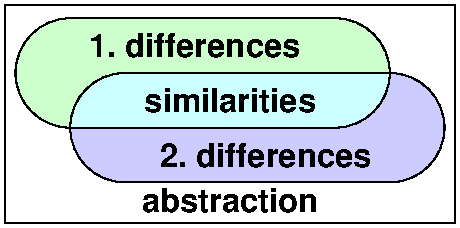
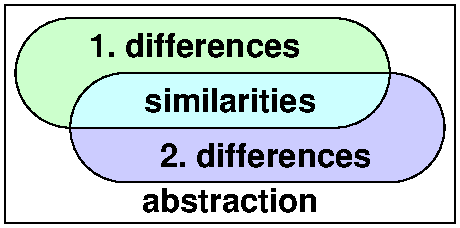
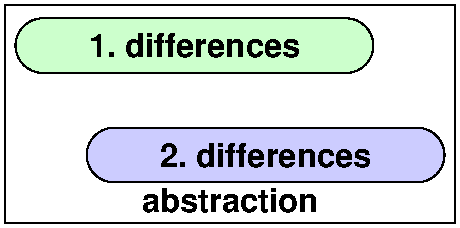
To
abstract is to
take away from the essentials and thereby to ignore certain differences.
The
similarity is what is the same. The
difference is what is different.
Human brains are built for complex abstraction.
The Latin word
"abstractus" ≈ "take away from". In abstract art, something is taken away, something remains, one needs to then interpret what is meant or intended.
50. Abstractions
In simple terms, "
abstraction" is looking at
similarities and ignoring
differences. The Latin word
"abstractus" ≈ "take away from".
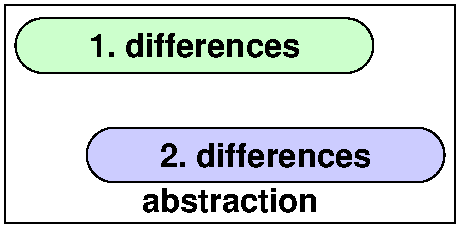
Sometimes there appear to be no similarities, only differences.
51. Henry Kissinger
Sometimes there
appear to be
no similarities between viewpoints.
Henry Kissinger (1923-2023) would try to get two parties to agree on something, often to
agree that they
disagreed. This is a self-referential paradox that was used to get the two sides talking.
Idea put into action: "
A peace without victory is a victory for peace".
- Congress of Vienna (1814-1815) [1816 Year without a summer]
- Treaty of Versailles (June 28, 1919)
52. World views
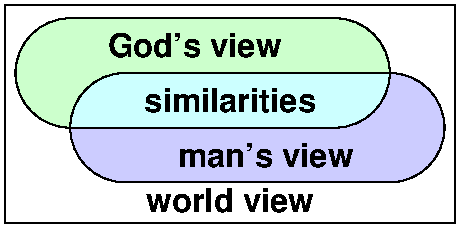
Many people would like to think that God's view and man's view are totally opposite (mutually exclusive) with no intersection. That is:
- Everything that is not God's view is man's view.
- Everything that is not man's view is God's view.
In reality, there are some similarities which makes it more difficult. The disagreement should be on what they are and to what extent they exist.
53. Thinking
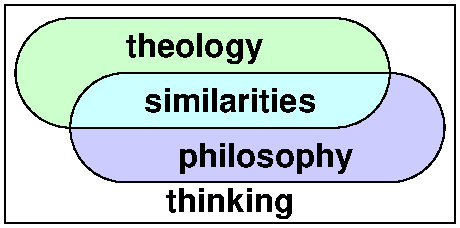
Many people would like to think that theology as God's view and philosophy as man's view are totally opposite (mutually exclusive) with no intersection.
If this were the case, thinking and decisions might be easier or, at least, more clear cut and not so ambiguous.
54. Philosophy
Philosophy is man's wisdom but there can be some overlap with God's wisdom.
1 Corinthians 1:25 Because the foolishness of God is wiser than men; and the weakness of God is stronger than men. [kjv]
Colossians 2:8 Beware lest any man spoil you through philosophy and vain deceit, after the tradition of men, after the rudiments of the world, and not after Christ. [kjv]
55. 1 Corinthians 1:25
KJV: Because the foolishness of God is wiser than men; and the weakness of God is stronger than men.
Greek: οτι το μωρον του θεου σοφωτερον των ανθρωπων εστιν και το ασθενες του θεου ισχυροτερον των ανθρωπων εστιν
56. Colossians 2:8
KJV: Beware lest any man spoil you through philosophy and vain deceit, after the tradition of men, after the rudiments of the world, and not after Christ.
Greek: βλεπετε μη τις υμας εσται ο συλαγωγων δια της φιλοσοφιας και κενης απατης κατα την παραδοσιν των ανθρωπων κατα τα στοιχεια του κοσμου και ου κατα χριστον
57. Similarity of self-sufficiency
Philippians 4:11 Not that I speak in respect of want: for I have learned, in whatsoever state I am, therewith to be content. [kjv]
ουχ οτι καθ υστερησιν λεγω εγω γαρ εμαθον εν οις ειμι αυταρκης ειναι [gnt]
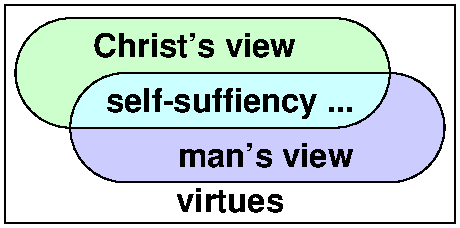
Paul appears to be saying that there is a "
virtue" in
"self-sufficiency". Some commentators will try to make this a verbal assault on the philosophy of the Stoics. Paul is just agreeing that in both God's view and in man's view,
"self-sufficiency" can be good.
However, self-sufficiency outside of Christ's view is
not good. Another name for the idea of
"self-sufficiency" is that of
"mammon".
58. Self-sufficiency
As a practical matter of the reality in which we live, one cannot be a "
bump on a log" and not do anything to be "
self-sufficient" in this world. Some examples:
- Parable of the 10 virgins, 5 prudent and 5 not-prudent
- Parable of the talents: no good news for the one not doing anything
So the saying that "
Christ is my self-sufficiency" as found in some commentaries is less than useful.
"
No man is an island".
59. No man is an island
The saying "
no man is an island" is from a poem by Englishman John Donne (1572-1631) in 1624.
No man is an Iland, intire of it selfe; every man is a peece of the Continent, a part of the maine; if a Clod bee washed away by the Sea, Europe is the lesse, as well as if a Promontorie were, as well as if a Mannor of thy friends or of thine owne were; any mans death diminishes me, because I am involved in Mankinde; And therefore never send to know for whom the bell tolls; It tolls for thee. Wikipedia
60. Ephesians
Throughout the letter to the Ephesians Paul talks about self-sufficiency and yet there is an interdependence and reliance and support of others as members of the body of Christ.
Paul summarizes this need to "
work together" in Ephesians 6 (the last chapter).
61. Difference of Christ
Two verses later Paul points out an important difference between God's view and man's view in terms of Christ.
Philippians 4:13 I can do all things through Christ which strengtheneth me. [kjv]
To be able to do "
all things" is a lot. It appears that Paul is saying that he is made "
stronger" or "
better" in "
everything" through Jesus Christ.
62. All things
- "All things" with no bounds is unrealistic.
- "Everything" within a given domain is more realistic.
Example:
- All things are possible for you.
- Everything that you can attempt to do (that exists) is possible.
63. Philippians 4:13 All things
Philippians 4:13 I can do all things through Christ which strengtheneth me. [kjv]
παντα ισχυω εν τω ενδυναμουντι με χριστω [gnt]
Can one really do "
all things"? There are many changes from the Greek.
- The word "Christ" is inferred from the pronoun "Him" as "τω" ≈ "(wrt) him/it".
- The Greek "in" is changed to "through".
- The Greek "am made strong", is changed to "can do".
- The Greek "all" with implied "these things" (i.e., in the previous verse) is changed to "all (things)".
- The Greek "potential to do" is changed to "strengtheneth".
Greek paraphrase:
In all these things (just mentioned), I am given potential (to accomplish) in Him.
It appears that Paul is saying that he is made "
stronger" or "
better" in "
everything" through Jesus Christ. This would include the adversity of neglect (from Phillipi) whereby he needed to be self-sufficient to continue the work of Christ.
64. Paul
Like Henry Kissinger getting two sides to agree that they disagree, Paul points out similarities that are important and then differences that are important. Paul does this in Athens.
Acts 17:23 For as I passed by, and beheld your devotions, I found an altar with this inscription, TO THE UNKNOWN GOD. Whom therefore ye ignorantly worship, him declare I unto you. [kjv]
65. Acts 17:23
KJV: For as I passed by, and beheld your devotions, I found an altar with this inscription, TO THE UNKNOWN GOD. Whom therefore ye ignorantly worship, him declare I unto you.
Greek: διερχομενος γαρ και αναθεωρων τα σεβασματα υμων ευρον και βωμον εν ω επεγεγραπτο αγνωστω θεω ον ο ουν αγνοουντες ευσεβειτε τουτον τουτο εγω καταγγελλω υμιν
66. Irony
67. Irony
In Greek philosophy, this was sometimes considered a vice and not a virtue since it could be used to deceive as in the English word
"hustle" as to "
take advantage of" through feigning "
inexperience", etc.
An interesting point here is that although many Greek philosophy words and terms are used in the Bible, the word for "
irony" as in "
feigned ignorance" as one way to "
deceive" is not in the Bible. Nor does that concept appear very often if at all.
... more to be added ...
68. End of page